


Chelsea, Middlesex, London
Up to 1834
On 3rd February, 1727, the officers of St Luke's Parish, Chelsea, agreed that "the Churchwardens be empowered to take, with all convenient speed, a proper house upon lease, in the name of this parish, for the use of the Poor." In 1734, three-quarters of an acre of land was donated by Sir Hans Sloane for St Luke's workhouse. The first building was erected in 1737 at the north side of the King's Road opposite Conduit Court. A substantial proportion of those entering the workhouse were doing so because of health reasons, and established St Luke's role as a hospital.
Some valuable material on the operation of the poor law and workhouse in Chelsea in the 18th century comes through some transcriptions of original records made by Tim Hitchcock, which he has very kindly allowed to be included here. These are:
- Judgments of settlement and bastardy examinations from 1733-1750
- Workhouse admissions and discharges from 1733-1799
The workhouse site is shown on the 1830 map below, at the east side of Arthur Street (now Dovehouse Street).
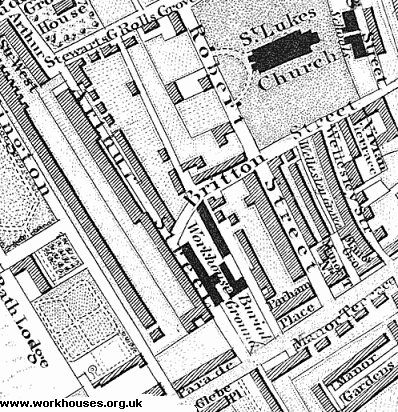
Chelsea workhouse site, 1830.
After 1834
Following the Poor Law Amendment Act of 1834, St Luke's was initially part of the Kensington Poor Law Union. However, it separated in 1841 and St Luke's Chelsea Parish Board was constituted.
Major building work was carried out at the Arthur Street site in 1843-44 including a new central range, master's house, vagrant's ward, and mortuary. In the 1860s, Bennet's Yard, a narrow thoroughfare at the east of the workhouse, was incorporated into the site and three new buildings were erected including guardians' offices and a register office fronting onto King's Road. In 1903-5, all three of the 1860s blocks were extended eastwards to front onto Sydney Street. The two northernmost blocks, each five storeys high, housed aged women and infirm women. The extended office building included the Guardians' board room and committee room, previously located in the infirm and aged women's blocks.
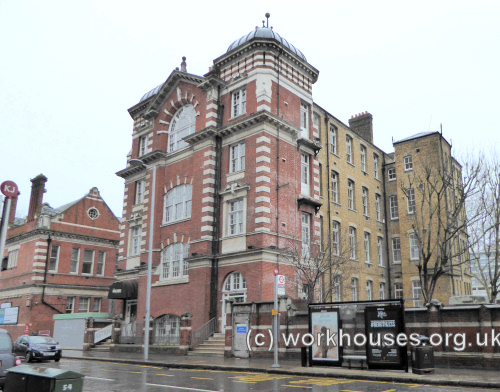
Former Chelsea Workhouse infirm women's block, from the north, 2018.
© Peter Higginbotham.
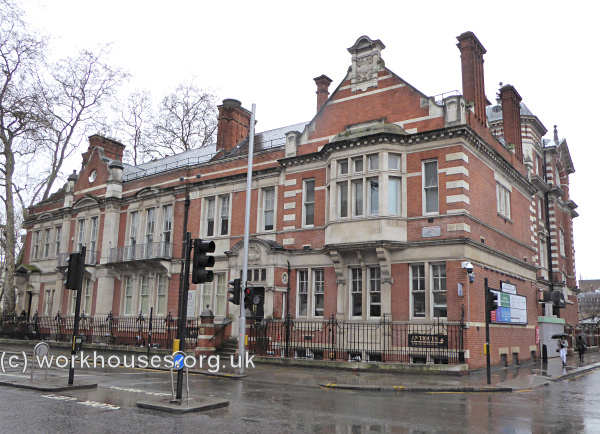
Former Chelsea Workhouse from the east, 2018.
© Peter Higginbotham.
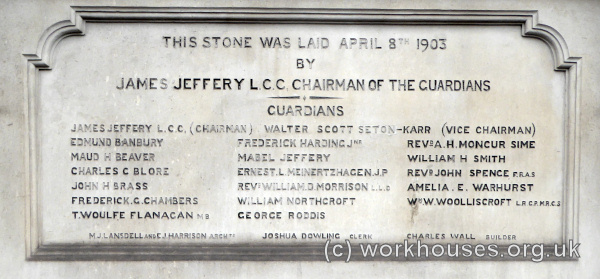
Chelsea Workhouse 1903 extension foundation stone, 2018.
© Peter Higginbotham.
In 1872, a new infirmary was erected on a narrow site running between Britten Street and Cale Street (TQ270782) and was linked to the workhouse by an underground tunnel. The original buildings, designed by Giles and Gough, were extended several times, including additions fronting onto Cale Street and Britten Street. The infirmary was renamed St Luke's Hospital in 1925. After being taken over by London County Council in 1930, it became the main acute general hospital for Chelsea. In June 1941, a direct bomb hit caused considerable damage to the hospital and its facilities. The hospital joined the NHS in 1948 and closed in 1974, with subsequent demolition of the building.
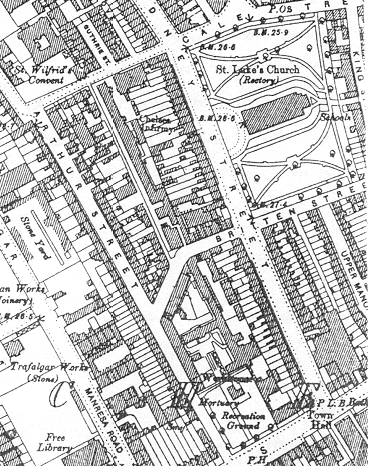
Chelsea workhouse and infirmary site, 1894.
An unusually lyrical depiction of workhouse is given by Chelsea Workhouse: A Bible Reading (Our Poor) painted in 1877 by James Charles. The picture shows a group of elderly female inmates sitting at a table, bathed in sunshine. Some drink tea while one of their number reads from the bible.
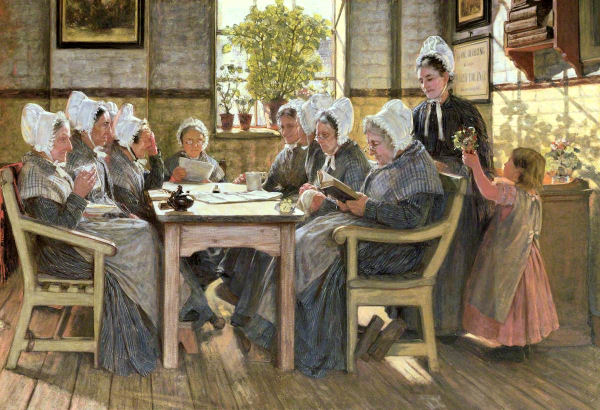
Chelsea Workhouse: A Bible Reading (1877)
A garden at the south of the workhouse, formerly a graveyard, was used as an airing ground for elderly inmates as shown in the 1907 illustration below. Many of the old tombstones were still standing, with others used as flagstones. The men wore distinctive red caps.
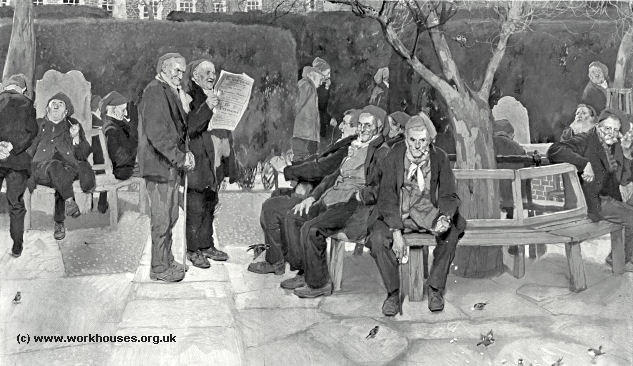
Chelsea elderly male inmates, 1907.
© Peter Higginbotham.
The London County Council took over the workhouse and infirmary in 1930. Except for the union offices on King's Road, and one of the women's blocks to ther rear, the buildings have now been demolished.
Fairfield House, Tooting
In 1894, Fairfield House, an old mansion on The Broadway, Tooting, was converted for use as a branch workhouse. It housed 135 inmates. The building was put up for sale in 1905 and demolished not long afterwards.
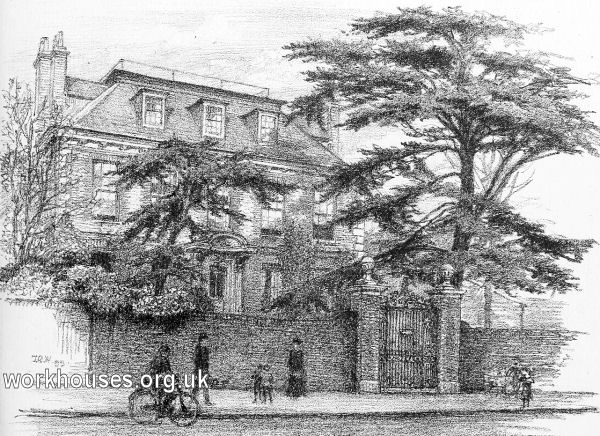
Chelsea branch workhouse, Fairfield House, Tooting, 1899.
© Peter Higginbotham.
Chelsea Casual Wards
Chelsea erected causal wards for vagrants on Milman's Street in 1893-4. The building was designed by the firm of A and C Harston.
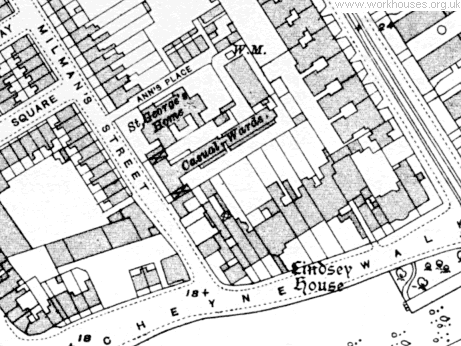
St George's Home site, 1916.
These, together with all the capital's other casual wards, were taken over in 1912 by the Metropolitan Asylums Board.
Staff
Inmates
- Long-term workhouse inmates (1861)
- 1881 Census — Chelsea workhouse
- 1881 Census — Chelsea workhouse infirmary
Records
Note: many repositories impose a closure period of up to 100 years for records identifying individuals. Before travelling a long distance, always check that the records you want to consult will be available.
-
The
Ancestry UK
website has two collections of London workhouse records (both name searchable):
- Westminster workhouse records are available on FindMyPast, .
- The London Archives, 40 Northampton Road, London EC1R OHB. Holdings for Chelsea include: Admissions and discharges (1872-1930); Creed registers (1914-27); Bastardy orders (1873-77); Registers of deserted women and children (1882-98); Guardians' minute books (1841-1930); etc.
Bibliography
- Higginbotham, Peter The Workhouse Encyclopedia (2014, The History Press)
Links
 For US readers
Unless otherwise indicated, this page () is copyright Peter Higginbotham. Contents may not be reproduced without permission.