

Willesden, Middlesex
The parish of Willesden originally belonged to the Hendon Poor Law Union which had been formed in 1835. By 1895, the Hendon workhouse at Edgware had become extremely overcrowded. Since the larger part of its inmates came from Willesden Parish, a local campaign was mounted to set up a workhouse at Willesden. In 1896, the Local Government Board and decided that Willesden should separate from the Hendon Union and operate as an independent Poor Law District. This came into effect on 13th August 1896. Poor relief was then administered by a new Board of Guardians, 21 in number — three from each of the parish's seven wards.
In 1897, the Guardians acquired a 60-acre site on the Twyford Abbey Estate on the north side of Acton Lane. On 10th April 1900, the foundation stone was laid for a new infirmary designed by A Saxon Snell. The original design comprised a central administrative block flanked on each side by three ward blocks which would accommodate a total of 616 inmates. In the event, only four blocks were built which housed 400 — 250 ordinary inmates and 150 sick. It was intended that these blocks would only accommodate the sick but were to be used temporarily for the old and infirm. The architect's site plan and "bird's eye view" of the buildings are shown below.
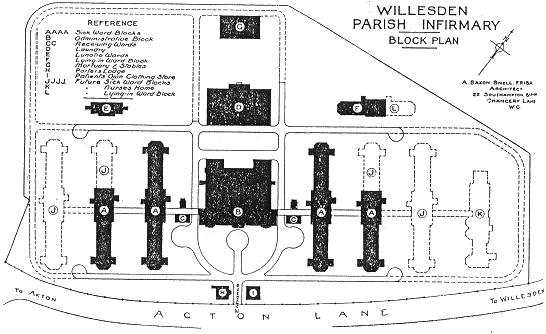
Willesden workhouse plan, 1903.
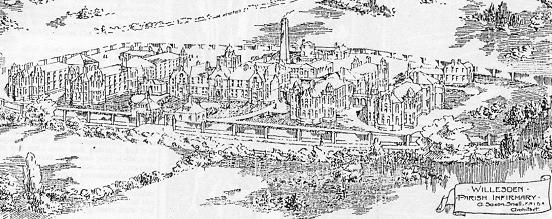
Willesden workhouse site, 1903.
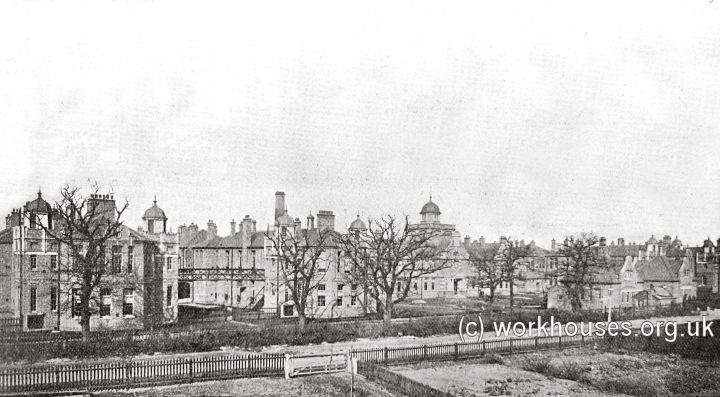
Willesden workhouse site, 1903.
At the front of the site, the entrance was flanked by a porter's lodge and a store for patients' own clothing. While in the infirmary, patients wore workhouse garb and their own clothing was stored away after being fumigated if necessary.
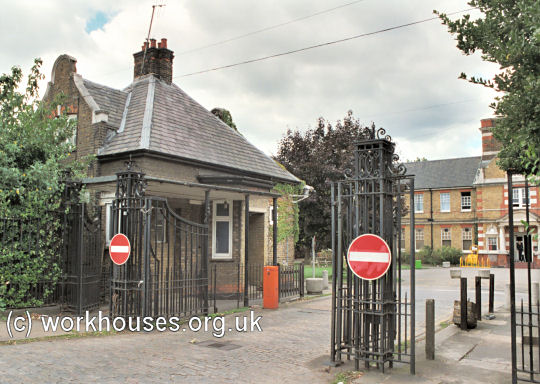
Willesden porter's lodge, 2001.
©Peter Higginbotham.
The main administrative block lay at the centre of the site with male and female receiving wards to each side.
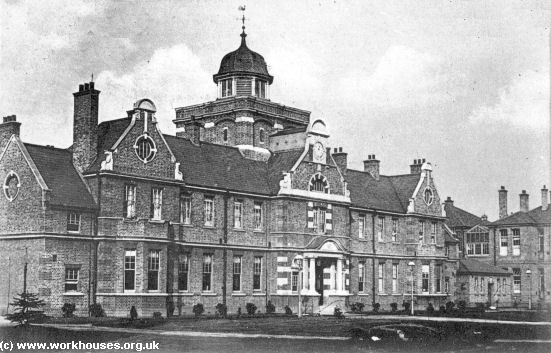
Willesden administrative block from the south, c.1910.
©Peter Higginbotham.
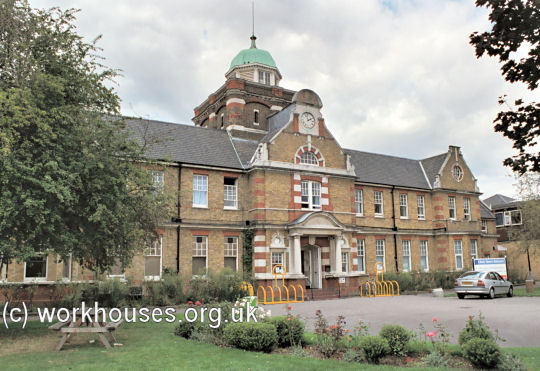
Willesden administrative block from the south, 2001.
©Peter Higginbotham.
A laundry and boiler-room stood to the rear of the administrative block. The building work cost just under £90,000 plus a further £8,627 for the installation of electric light and power — generators were located at the rear of the laundry. The building was mainly heated by open fires, although hot water pipes provided a minimal form of central heating.
The ward blocks had two wards on each floor, each holding 22 beds. Each ward had a "well-lighted and cheerful" day room and projecting sanitary towers.
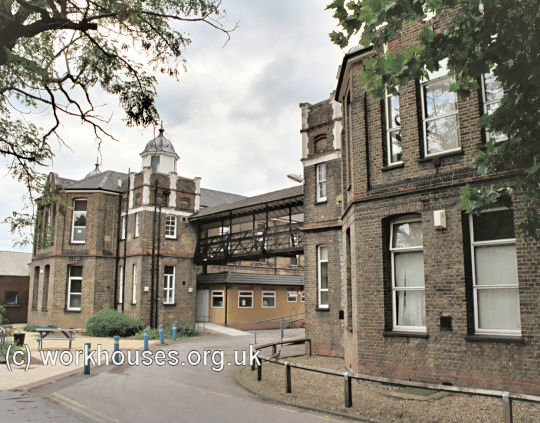
Willesden infirmary wards from the north-west, 2001.
©Peter Higginbotham.
In a second phase of building in 1907-8, workhouse blocks were erected at the north of the infirmary. They comprised male and female pavilions, each holding 100 able-bodied inmates, a receiving block and clothing store, and a dining hall. The architect was again A Saxon Snell. The buildings cost £19,000 and were formally opened in December 1908 with the Guardian's Chairman Joseph Chamberlain presiding over the proceedings.
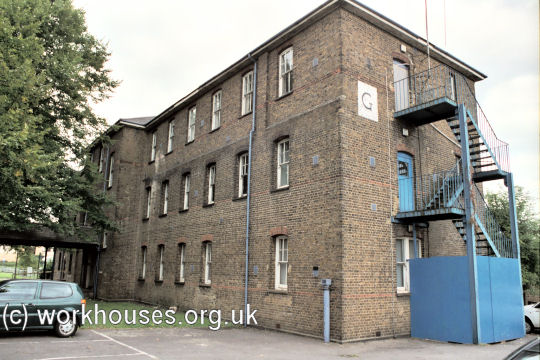
Willesden female workhouse block, 2001.
©Peter Higginbotham.
What was originally the new workhouse dining hall was later adapted for uses as a 50-bed nursery block, with its own garden and sand-pit. Children's homes were also built to the north-east of the workhouse.
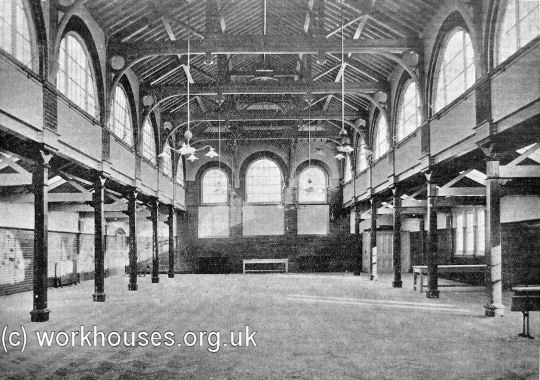
Willesden workhouse dining hall, 1908.
©Peter Higginbotham.
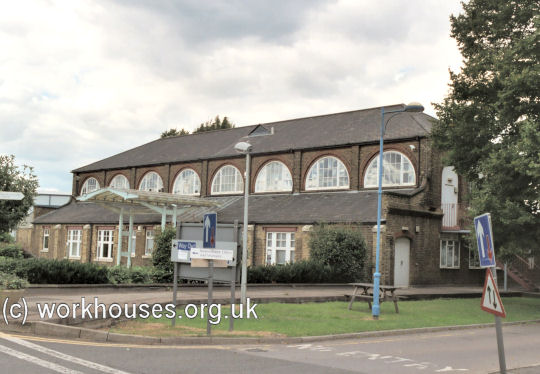
Willesden nursery block from the south-east, 2001.
©Peter Higginbotham.
Two pavilions for the aged and infirm of each sex were erected adjacent to the corresponding able-bodied blocks. The layout of the workhouse in 1915 is shown on the OS map below.
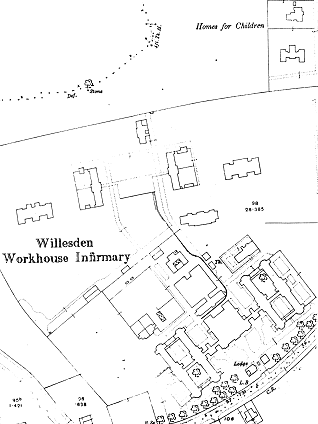
Willesden workhouse site, 1915.
In 1914, the workhouse was renamed Willesden Institution, and then in 1921 became Park Royal Hospital. However, to protect those born in the institution from stigma in later life, their place of birth was recorded as "Twyford Lodge". On 1st April 1930, the workhouse came under the control of Middlesex County Council and was renamed the Central Middlesex County Hospital. After the introduction of the National Health Service in 1948 it became the Central Middlesex Hospital.
Almost all the old buildings have now been demolished to make way for a new hospital.
Children's Homes
As shown on the map above, the Willesden Union erected children's homes at the north of the workhouse on Barret's Green Road. By 1914, the Union also had a children's home at 2 Hill Side, Stone Bridge, Willesden, with Miss Lucy Bowmna as foster mother. By the early 1920s, the union was operating sixteen scattered homes at various locations in Cricklewood and Harlesden accommodating a total of 230 children.
Bibliography
- Higginbotham, Peter Workhouses of London and the South East (2019)
- Gray, JD Allan (1963) The Central Middlesex Hospital (Pitman Medical Publishing).
Records
Note: many repositories impose a closure period of up to 100 years for records identifying individuals. Before travelling a long distance, always check that the records you want to consult will be available.
-
The
Ancestry UK
website has two collections of London workhouse records (both name searchable):
- Westminster workhouse records are available on FindMyPast, .
- London Metropolitan Archives, 40 Northampton Road, London EC1R OHB. Holdings include: Guardians' minutes (1896-1930); Admissions and discharges (1911-47); Creed registers (1900-51); Lists of pauper children (1900-53).
 For US readers
Unless otherwise indicated, this page () is copyright Peter Higginbotham. Contents may not be reproduced without permission.