

Kilrush, Co. Clare
Kilrush Poor Law Union was formally declared on the 1st August 1838 and covered an area of 180 square miles. Its operation was overseen by an elected Board of Guardians, 29 in number, representing its 13 electoral divisions as listed below (figures in brackets indicate numbers of Guardians if more than one):
Co. Clare: Kilballyoan, Kildysert (2), Kilfidduan (2), Kilkee (3), Killard (2), Killiner, Killofin (2), Kilmacdooaun (2), Kilmihil, Kilmurry (4), Kilrush (5), Knock, Moyarta (3).
The Board also included 9 ex-officio Guardians, making a total of 38.
The population falling within the Union at the 1831 census had been 70,676 with divisions ranging in size from Kilballyoan (population 3,695) to Kilrush itself (9,850).
The new Kilrush Union workhouse was erected in 1840-41 on a six-acre site at the north of Kilrush. Designed by the Poor Law Commissioners' architect George Wilkinson, the buildings were planned to accommodate 800 inmates. Its construction cost £6,800 plus £1,350 for fittings etc. The workhouse was declared fit for the reception of paupers on 15th December 1841, and received its first admissions on 9th July 1842.
The workhouse location and layout are shown on the 1920 map below.
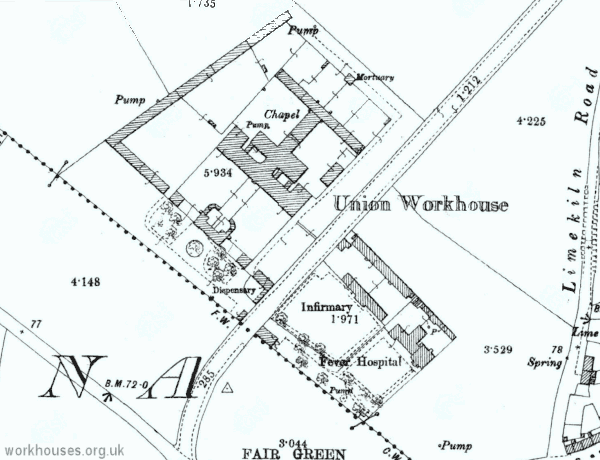
Kilrush workhouse site, 1920.
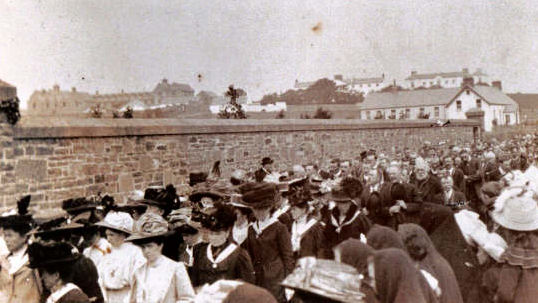
A distant view of Kilrush (left) from the early 1900s
Courtesy of Patrick Cusack
The buildings followed Wilkinson's typical layout. An entrance and administrative block at the south-west of the site contained a porter's room and waiting room at the centre with the Guardians' board room on the first floor above.
The main accommodation block had the Master's quarters at the centre, with male and female wings to each side which included boys' and girls' schoolrooms.
At the rear, a range of single-storey utility rooms such as bakehouse and washhouse connected to a central spine containing the chapel and dining-hall. A block at the rear contained the original hospital and idiots' wards. A separate infirmary and fever hospital were subsequently erected on the opposite side of the road, with the original infirmary being used as lunatic wards. A dispensary was located near the workhouse entrance gate.
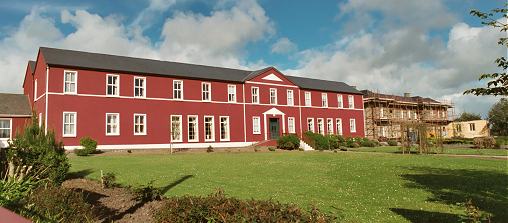
Kilrush infirmary and fever hospital from the west, 2002
© Peter Higginbotham.
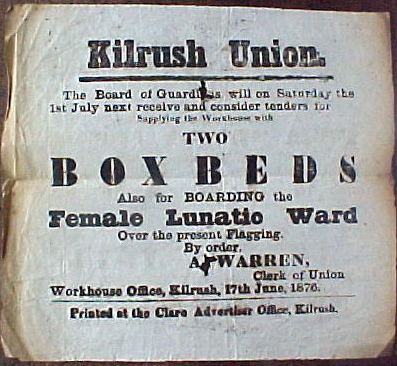
Kilrush request to tender notice, 1876
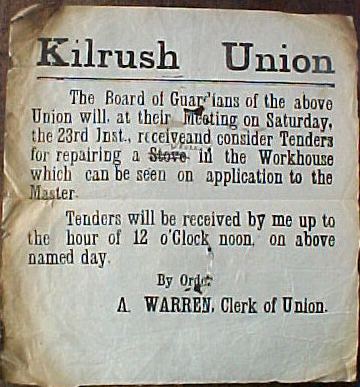
Kilrush request to tender notice, 1876
The map above shows a long range of buildings along the northern boundary of the site. These were probably single-storey sheds erected as emergency additional accommodation during the Great Famine in around 1847.
In February 1850, at the end of the famine years, social campaigner Dr Richard Robert Madden wrote a vivid report on conditions that still existed at the Kilrush workhouse. Here is an extract:
You can read the full text of Madden's account kindly contributed by Ian Beard, whose Great-grandmother was an inmate of the workhouse at the time.
In 1852, the eastern part of the Kilrush Union went to form part of the new Kildysart Union.
In the latter part of the nineteenth century, nursing at the workhouse was performed by nuns from the Sisters of Mercy order. In 1903, a total of four were employed.
In 1895, Kilrush was visited by a "commission" from the British Medical Journal investigating conditions in Irish workhouse infirmaries. Their report suggested a number of improvements: the construction of a new fever hospital, with the existing one being used to expand the capacity of the infirmary; improvements in the nurseries and the provision of running water and better sanitation throughout the buildings. Further details are available in the full report.
After the creation of the Irish Free State in 1922, the main workhouse site became the County Nursery for unmarried mothers and infant children. After it closed in 1932, the buildings were demolished and a school and housing now occupy the site.

Kilrush main former main workhouse site from the south-east, 2002
© Peter Higginbotham.
In 1922, the workhouse infirmary and fever hospital became the Kilrush District Hospital. All operations carried out in the district were performed at the hospital, despite patients having to be taken out of doors to reach the operation room. In 1927, the fever hospital still had no water supply and no bathing or sanitary accommodation. The site is still in use as as day hospital.
Records
Note: many repositories impose a closure period of up to 100 years for records identifying individuals. Before travelling a long distance, always check that the records you want to consult will be available.
- Clare County Library, The Manse, Harmony Row, Ennis.
- Kilrush Minute Books 1849
Bibliography
- Madden, Richard Robert (1850) The Memoirs (Chiefly Autobiographical) from 1798 to 1886 of Richard Robert Madden
- Crossman, V (2006) Politics, Pauperism and Power in Late Nineteenth-century Ireland
- Gray, P (2009) The Making of the Irish Poor Law, 1815-43
- O'Connor, J (1995) The Workhouses of Ireland


Links
- Transcript of Board of Guardians' Minutes (1849)
- The Great Hunger - Irish famine resources. (Archived)
 For US readers
Unless otherwise indicated, this page () is copyright Peter Higginbotham. Contents may not be reproduced without permission.