

Knighton, Radnorshire
Up to 1834
Knighton's first workhouse dates from around 1795. Eden, in his 1797 survey of the poor in England (and parts of Wales), reported of Knighton that:
After 1834
Knighton Poor Law Union was formed on 9th November, 1836. Its operation was overseen by an elected Board of Guardians, 23 in number, representing its 20 constituent parishes as listed below (figures in brackets indicate numbers of Guardians if more than one):
County of Radnor:
Bleddfa, Heyhop, Knighton (2), Llanbadarn Fynydd, Llanbister (2), Llandewi Ystradenny, Llanfihangel Beguildy (2), Llanfihangel Rhydithon, Llangynllo, Llannano, Stanage.
County of Hereford:
Adforton, Stanway, Paytoe and Grange, Bampton Bryan, Buckton and Coxwall, Walford, Letton and Newton.
County of Salop:
Bedstowe, Bettws y Crwyn, Bucknell, Llanvair Waterdine, Stowe.
Later additions: Cascob, Discoes, Litton and Cascob, Norton, Pilleth, Presteigne, Whitton (all from 1877).
The population falling within the union at the 1831 census had been 8,719 with parishes ranging in size from Stowe (population 147) to Knighton itself (1,259). The average annual poor-rate expenditure for the period 1834-36 had been £4,003 or 9s.2d. per head of the population.
Knighton Union workhouse was erected in 1837 at the south side of Ffrydd Lane (later Ffrydd Road) to the south of Knighton. The Poor Law Commissioners authorised an expenditure of £1,800 on construction of the buildings which was to accommodate 120 inmates. By the 1880s, the buildings had become dilapidated and inadequate and the workhouse was rebuilt in 1886. The architect for the reconstruction was Edward Jones of Newton and the building work was undertaken by John Williams of Knighton. The location and layout of the reconstructed workhouse are shown on the 1903 map below.
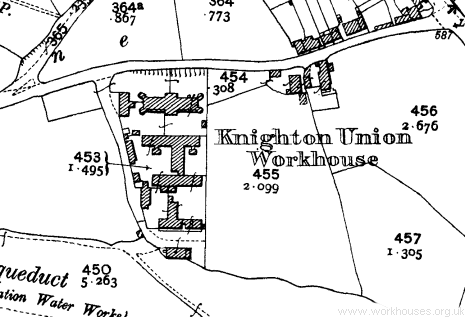
Knighton workhouse site, 1903
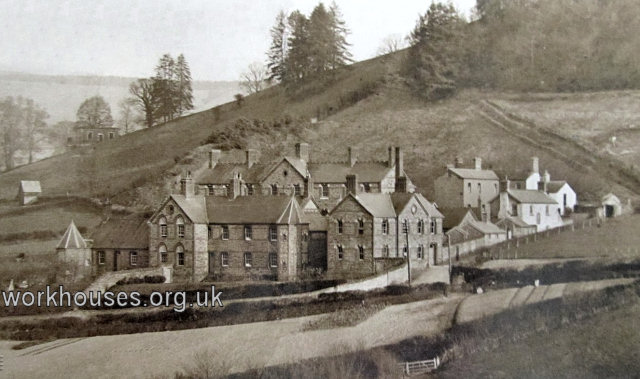
Knighton workhouse from the north-west, c.1916.
After the rebuilding, a boardroom block at the north-west of the site contained a waiting room and offices for the clerk and relieving officer on the ground floor, with the boardroom and committee room above. The infirmary lay to its east, with octagonal sanitary towers at each corner. It contained male and female wards and day rooms, plus WCs, baths, and nurses' rooms. To the south of the infirmary, the main block had the master and matron's quarters at its centre, with male and female day rooms, dormitories etc. to each side. The dining-room, at right angles to the main building, connected to a block containing the kitchen, scullery, stores and laundry. The children's block at the south of the site was an enlargement of the existing building.
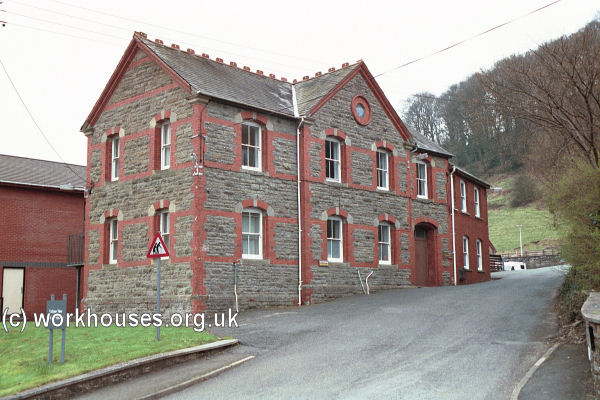
Knighton workhouse 1886 boardroom block from the north-west, 2000.
© Peter Higginbotham.
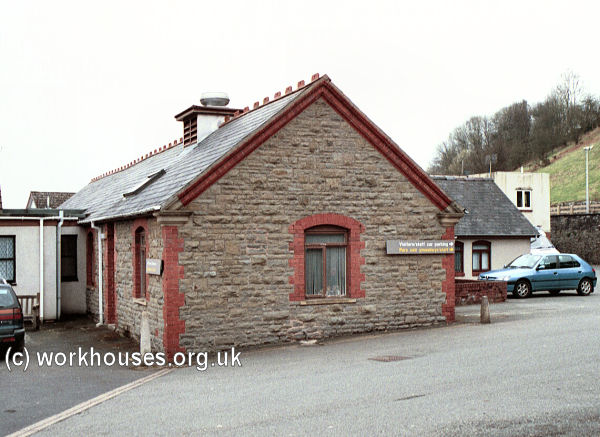
Knighton workhouse 1886 laundry block from the north-west, 2000.
© Peter Higginbotham.
In 1877, the union was enlarged by the addition of seven parishes and townships that previously formed part of the dissolved Presteigne Union.
On 12 December 1907, an explosion in the administrative block killed the workhouse master, Richard Morgan Butler, who was investigating a gas leak with the aid of a lit candle. There were no other casualties but the block was severely damaged.
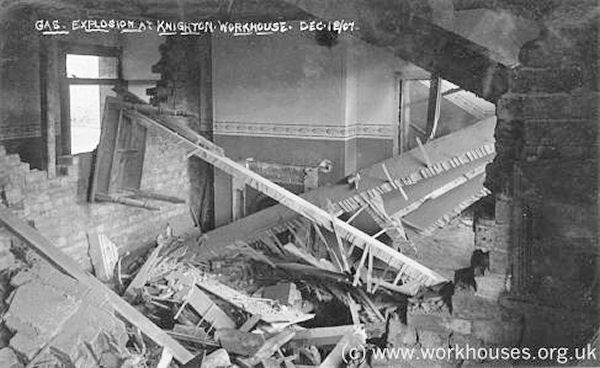
Knighton workhouse gas explosion, 1907.
© Peter Higginbotham.
During the First World War, the workhouse served as as Red Cross Hospital.
By the 1920s, the workhouse was officially known as Offa's Lodge Poor Law Institution. After 1930, the workhouse became a Public Assistance Institution run by Radnorshire Council, then after 1948 it joined the new National Health Service as Knighton Hospital. The site is still occupied by a local hospital but most of the old workhouse buildings have now been replaced.
Staff
Inmates
Records
Note: many repositories impose a closure period of up to 100 years for records identifying individuals. Before travelling a long distance, always check that the records you want to consult will be available.
- Powys County Archives Office, Unit 29, Ddole Road Enterprise Park, Llandrindod, LD1 6DF. Relatively few records survive — holdings include: Guardians' minute books (1901-30); Ledgers (1922-30); List of paupers (1838); etc.
Bibliography
- Higginbotham, Peter The Workhouse Encyclopedia (2014, The History Press)
- NEW! Workhouses of Wales and the Welsh Borders. The story of the workhouse across the whole of Wales and the border counties of Cheshire, Gloucestershire, Herefordshire and Shropshire. More...
Links
 For US readers
Unless otherwise indicated, this page () is copyright Peter Higginbotham. Contents may not be reproduced without permission.