


Hoo, Kent
Up to 1834
A parliamentary report of 1777 recorded a local workhouse in operation at Allhallows with accommodation for up to 6 inmates.
After 1834
Hoo Poor Law Union officially came into existence on 9th September 1835. Its operation was overseen by an elected Board of Guardians, 8 in number, representing its 7 constituent parishes as listed below (figures in brackets indicate numbers of Guardians if more than one):
County of Kent: Allhallows, Cooling, High Halstow, Hoo, St James — Isle of Grain, St Mary, Stoke.
The population falling within the Union at the 1831 census had been 2,623 — with parishes ranging in size from from Cooling (population 131) to Hoo itself (910). The average annual poor-rate expenditure for the period 1833-5 had been £2,419 or 18s.5d. per head of the population.
The Hoo Union workhouse was erected in 1836 on the south side of main road at the west of Hoo St Werburgh. It was designed by Assistant Poor Law Commissioner Sir Francis Head using the "courtyard" plan the he had originated. An outer perimeter of buildings enclosed a large courtyard, with the archway entrance (here at the north of the site) opening into a smaller inner yard.This type of layout was employed by a number of Kent Unions including Blean, Bridge, Eastry, East Ashford, Faversham and Maidstone. In 1835, the Poor Law Commissioners authorised an expenditure of £2,300 on construction of the building which was to accommodate 160 inmates. The workhouse location and layout are shown on the 1897 map below:
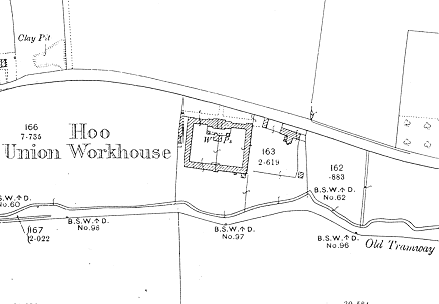
Hoo workhouse site, 1897.
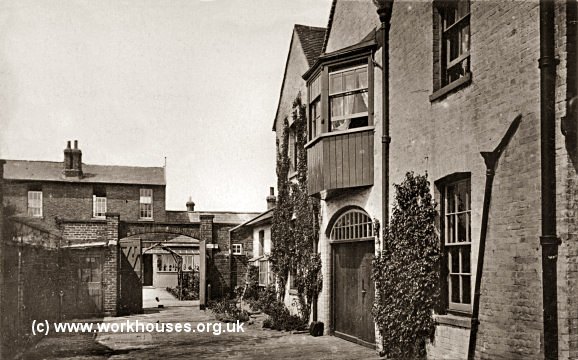
Hoo workhouse — view from yard inside entrance gateway, c.1912
© Peter Higginbotham.
After 1930, the workhouse buildings were used as local council offices but were demolished in the 1960s.
In December 1840, The Times, which opposed the New Poor Law and regularly gave prominence to stories critical of the workhouse system, published a story from their "Rochester Correspondent" alleging serious misconduct by the master at Hoo, James Miles.
Miles, a former baker, whom the Times described a "sinewy strong man", was subsequently revealed to have a medical complaint requiring violent exercise for the preservation of his health. This, commented the paper, was apparently remedied through two regular activities — hunting, and the beating of children. Miles was dismissed from his post but apparently not prosecuted.
Staff
Inmates
Records
Note: many repositories impose a closure period of up to 100 years for records identifying individuals. Before travelling a long distance, always check that the records you want to consult will be available.
- Medway Archives Centre, 32 Bryant Road, Strood ME2 3EP. Holdings include: Guardians' minutes (1835-1930); Births (1838-1922); Deaths (1838-1922); Creed register (1869-82, 1900-23); Admissions and discharges (1906-23); Punishment books (1851-1918); Ledger (1835-1930, with gaps); etc.
- Medway
has: Workhouses dmissions and discharges (1906-23); Hospital admissions and discharges (1899-1924); Births (1838-45, 1848-76, 1881-1914); Deaths (1827-78, 1881-1917); Creed registers (1869-82, 1900-22); Lunatics register (1928); Punishment book (1851-1916); Removals (1842-1929).
Bibliography
- Higginbotham, Peter Workhouses of London and the South East (2019)
Links
- None.
 For US readers
Unless otherwise indicated, this page () is copyright Peter Higginbotham. Contents may not be reproduced without permission.