


Morpeth, Northumberland
Up to 1834
In 1764, an advertisement appeared in the Newcastle Courant for a master for the Morpeth parish workhouse. Applicants were invited to submit their details, in writing, to the Morpeth churchwardens or to Mr Edward Chaloner, butcher, who was to be found every Saturday at the Newcastle flesh-market. A parliamentary report of 1777 recorded the Morpeth workhouse as having accommodation for up to 24 inmates. The workhouse was located on Newgate Street.
The old hall at Bedlington, at the south side of what is now Front Street West, was converted for use as a parish workhouse and in 1776 could house sixty inmates.
A workhouse also existed at East and West Thirston.
After 1834
Morpeth Poor Law Union was formed on 27th September 1836. Its operation was overseen by an elected Board of Guardians, 77 in number, representing its 72 constituent parishes and townships as listed below (figures in brackets indicate numbers of Guardians if more than one):
County of Northumberland:
High Angerton, Low Angerton, Ashington and Sheepwash, Benridge, Biggs [Bigge's] Quarter, Bockenfield, Bothal Demesne, Buller's Green, Bullock's Hall, Cambo, Causey Park, East Chevington, West Chevington, Cockle Park, Corridge, Cresswell, Deanham, Earsdon, Earsdon Forest, East and West Thirston, Edington, Ellington, Eshot [Eshott], Fenrother, Freeholder's Quarter, Hadstone [Hadston], Hartburn, Hartburn Grange, Hebron, Hepscott, Highlaws, High and Low Highlaws, Hirst, Longhurst [Longhirst], Longshaw's Quarter, Long Witton [Longwitton], Linmouth [Lynmouth], Meldon, North Middleton, South Middleton, Mitford, Molesdon, Morpeth (4), Morpeth Castle, Netherwitton, Newbiggen-on-the-Sea [Newbiggin], Newminster Abbey, Newton Park, Newton-under-wood [Underwood], Nundriding, Old Moor, Pegswood, Pigdon, Riddell's Quarter, Rivergreen, North Seaton, Shothaugh, Spittle [Spital] Hill, Stanton, East Thornton, West Thornton, Thropple [Throphill], Todridge, Tranwell and High Church, Tritlington, Ulgham, Wallington Demesne, Whitridge, Widdrington, Witton Shields, Woodhorn, Woodhorn Demesne.
County of Durham: Bedlington (3).
Later Additions: Horlsley, Long Horsley Common, Newminster.
The population falling within the Union at the 1831 census had been 14,340 with parishes ranging in size from Todridge (population 4) to Morpeth itself (3,890). The average annual poor-rate expenditure for the period 1834-6 had been £5,329 or 7s.5d. per head of the population.
The union took over the existing workhouse on Newgate Steet, Morpeth. In February 1837, the guardians advertised: "Wanted to purchase, a piece of ground containing not less than One, nor more than Two Acres, situated in the Township of Morpeth or Buller's Green, for the Purpose of erecting a Workhouse upon." However, it seems that they subsequently decided to continue to use the existing Newgate Street site.
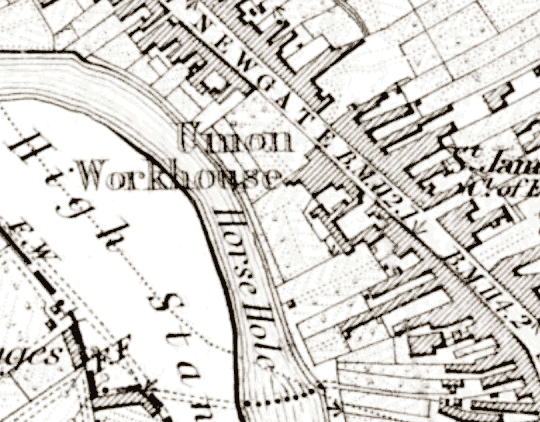
Morpeth workhouse site 1859.
The old workhouse at Bedlington was also initially used by the union for a time. In October 1837, it was reported that one of its inmates, 91-year-old Thomas Holburn, who had been completely blind for twelve years, had had his sight suddenly restored whilst at dinner and was now going around the village, recognising his old acquaintances and haunts.
In 1853, the workhouse master, William Robinson, was accused of indecent conduct towards the female inmates. An inquiry by the Poor Law Board resulted in his resignation.
In 1865-7, the Newgate Street workhouse was rebuilt on the existing site to a design by Frederick R Wilson. The new layout is shown on the 1920 map below:.
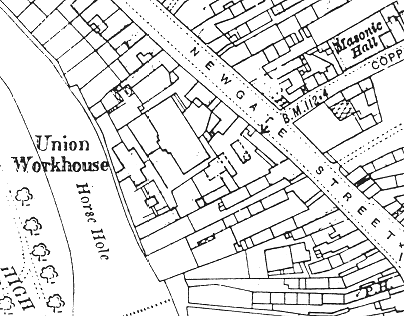
Morpeth workhouse site 1920.
In 1913, the Guardians agreed to buy seven acres of land on the Grange House Estate, at the north side of Mitford Road, on which to build a workhouse infirmary. Perhaps because of the onset of the First World War, the proposed scheme appears not to have been pursued.
The workhouse buildings were used as county council offices during the Second World War. The buildings were demolished in 1951 and replaced by a telephone exchange.
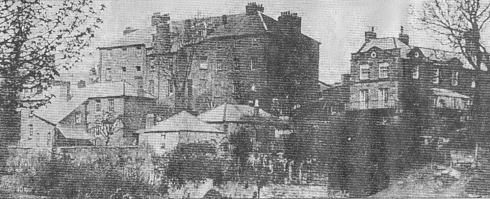
Morpeth workhouse.
Morpeth Cottage Homes
In 1905-6, the union erected girls' cottage homes development at Pottery Bank to the north of Morpeth.
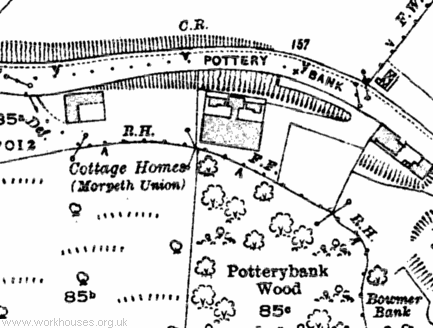
Morpeth cottage homes site, 1920.
The opening of the homes in April 1906 was the subject of a report in the Building News:
A cottage home for 18 boys was subsequently opened in an area known as High Stanners, on what is now Abbey Terrace.
Staff
Inmates
Records
Note: many repositories impose a closure period of up to 100 years for records identifying individuals. Before travelling a long distance, always check that the records you want to consult will be available.
- Northumberland Collections Service, Woodhorn, Queen Elizabeth II Country Park, Ashington, Northumberland NE63 9YF. Virtually no local records survive — holdings comprise Guardians' minutes (1902-5); Ledger (1923-30).
Bibliography
- Gubbins, Bridget (2013) The Mysteries of Morpeth's Workhouse (135 A4-sizedd pages, fully illustrated). Copies available from the Greater Morpeth Development Trust at £10.99 plus £3.01 postage and packing. To order, please phone 01670-515790 or email laura.robinson@gmdt.org
Links
- None.
 For US readers
Unless otherwise indicated, this page () is copyright Peter Higginbotham. Contents may not be reproduced without permission.