

Penkridge (Cannock from 1877), Staffordshire
Up to 1834
A parliamentary report of 1777 recorded parish workhouses in operation at Penkridge (for up to 40 inmates), Brewood (30), and Chesland Hay (12). The Penkridge workhouse stood on Cannock Road (formerly Husbandman Street) opposite Reynolds Cottage.
Brewood's workhouse was originally on the lane leading to Kiddemore, between the Churchfields and Hockerill, but moved in around 1800 to premises on Bargate.
Church Eaton's parish workhouse was erected in 1798.
Norton-in-Cannock (Norton Canes) had a workhouse on what is now School Road.
Bushbury erected a workhouse in 1831 at what is now the junction of Primrose Avenue and Bee Lane. The building was remodellws in more recent times for use as a doctor's surgery but the original brickwork can still be seen at ground level.
Former Bushbury parish workhouse.
After 1834
The Penkridge Poor Law Union formally came into being on 29th September 1836. Its operation was overseen by an elected Board of Guardians, 30 in number, representing its 21 constituent parishes as listed below (figures in brackets indicate numbers of Guardians if more than one):
County of Stafford:
Acton and Bednall, Brewood (4), Bushbury (2), Cannock (2), Cheslyn Hay, Church Eaton (2), Coppenhall, Dunston, Essington, Featherstone, Hatherton, Hilton, Huntington, Kinvaston, Lapley and Wheaton Ashton (2), Norton-under-Cannock (Norton Canes)(2), Penkridge (2), Saredon, Shareshill, Stretton, Great Wyrley.
Later addition: Teddeslaey Hay (1858)
Initially, the new Penkridge Union made use of an existing workhouse building on Bargate Street, Brewood, built in around 1800 and enlarged in 1838.
In 1870-1, a new workhouse was built at a site on Wolverhampton Road to the west of Cannock. The new workhouse could accommodate about 200 inmates and cost around £8,000 to build. Its location and layout are shown on the 1915 map below:
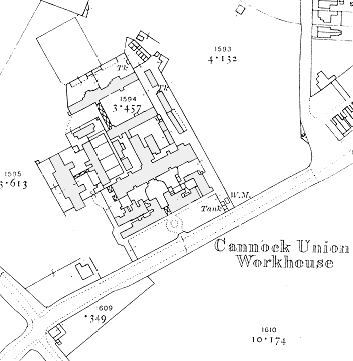
Cannock workhouse site, 1915.
In 1870, a report in The Builder magazine provided details of the building.
ERECTION OF A NEW WORKHOUSE FOR PENKRIDGE.
The Guardians of the Penkridge Union having selected a suitable site at Cannock, the new workhouse is now being erected under the direction of Mr. Edwd. Holmes, architect, of Birmingham. The general aspect of the proposed building is south. The front block has been set apart for the board offices, immediately behind which is placed the vagrants' and receiving wards. The main block of the building runs parallel with the board offices. The dining-hall and also the kitchen-offices communicate with the main building and schools by means of corridors. The general school, boys' day-room, and play-ground are on the right of the dining-hall, while the girls' are on the left. Spacious dormitories are arranged on the first floor of this building. The infirmary, comprising the sick wards, occupies the western portion of the site, and the fever wards, which are also a detached building, are placed on the north end of the site. The accommodation provided in the main building is for 47 infirm and aged males and 10 able-bodied males, making a total of 57 males ; and for 39 infirm and aged females and 20 able-bodied,—total, 59 females. The dining-ball is 38 ft. by 24 ft. 6 in., and will be arranged so that each class of adults as well as children may assemble without mixing; a division up the centre will separate the males from the females. It is intended to use the dining hall as a chapel. Schools are provided for 24 boys and 31 girls and infants. The accommodation provided for in the infirmary is as follows:-Males, sick, 9; itch, 4; fever, 4; total, 17: females, sick, 5; itch, 4; lying-in, 4; fever, 4 ; total, 17. The method adopted for ventilating the building is by the use of air-bricks covered on the inside with finely perforated zinc, to be inserted at distances of from 8 ft. to 10 ft. apart near the floor level, and over them near the ceiling, except where the rooms are ceiled above the wall-plates, in which case circular ventilators, 16 in. diameter, will be placed in the ceiling and covered on the under-side with perforated zinc. Louvres will also be provided in the roofs. The building will be constructed of brick with stone dressings. The estimated cost is 6,745l. Messrs. Parnell & Son, of Rugby, are the builders.
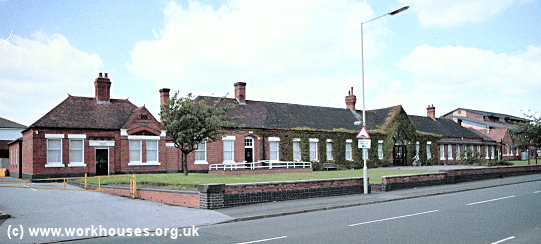
Cannock entrance block from the south, 2000.
© Peter Higginbotham.
The buildings were extended in 1886 at a cost of £800 with the provision of detached fever wards. In 1902, £6,350 was spent on the erection of a new infirmary.
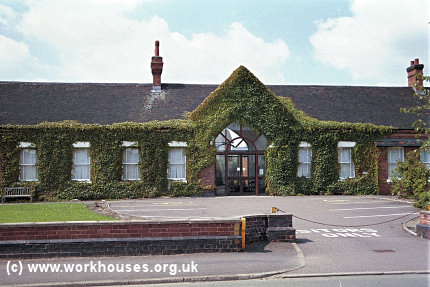
Cannock main entrance from the south-east, 2000.
© Peter Higginbotham.
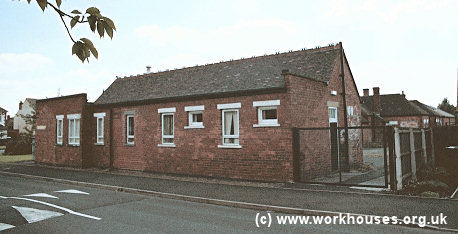
Cannock front block from the north-east, 2000.
© Peter Higginbotham.
On 14th March, 1877, the Penkridge Union was renamed the Cannock Union.
In 1930, the workhouse was taken over by Staffordshire County Council and became a Public Assistance Institution, still housing the elderly poor, chronic sick etc. The inmates enjoyed the occasional outing to the countryside or seaside as shown in the picture below from 1937.
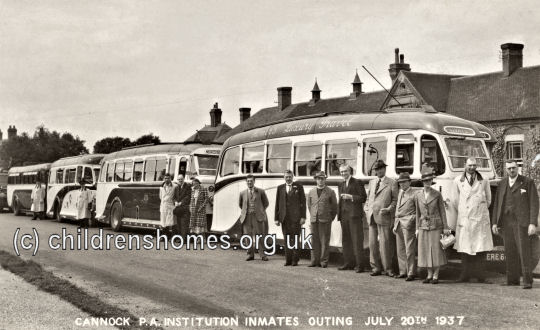
Cannock PAI inmates' outing, 1937.
© Peter Higginbotham.
The former establishment subsequently became known as Chase Hospital and then as Ivy House providing maternity and geriatric care. An adjacent house known as "The Cottage" was also used as temporary accommodation for homeless families, single mothers etc. A former resident recalls:
In 2013, the only surviving part of the building, the entrance block, was under threat of demolition.
Children's Home
In around 1914, the Cannock Union established a children's cottage home at Old Penkridge Road, Cannock. In 1924, the home could house 31 children and the superintendent was H.H. Rosser. By 1929, the home's capacity had increased to 61. The site later became a Remand Home and then Lynwood children's home. It is now in private residential use.
Former Cannock Union cottage homes.
Staff
Inmates
Records
Note: many repositories impose a closure period of up to 100 years for records identifying individuals. Before travelling a long distance, always check that the records you want to consult will be available.
- Staffordshire Record Office, Eastgate Street, Stafford, ST16 2LZ. Holdings include Guardians' minute books (1836-45); Ledgers (1927-1930); Outdoor relief lists (1836, 1839); etc.
Bibliography
- Whitehouse, Sam (2020) Norton Canes Poor Law Relief and the Workhouse.
Links
- None.
 For US readers
Unless otherwise indicated, this page () is copyright Peter Higginbotham. Contents may not be reproduced without permission.