

Oldcastle, Co. Meath
Oldcastle Poor Law Union was formally declared on the 6th January 1840 and covered an area of 169 square miles. Its operation was overseen by an elected Board of Guardians, 21 in number, representing its 13 electoral divisions as listed below (figures in brackets indicate numbers of Guardians if more than one):
Co. Meath:
Crossakeel, Killallon, Loughcrew, Killeagh, Moylagh, Oldcastle (2).
Co. Westmeath:
Castle Pollard (2), Fore (2).
Co. Cavan:
Ballyjamesduff (2), Castlerahan (2), Kilbride (2), Munterconnaught, Virginia (3).
The Board also included 7 ex-officio Guardians, making a total of 28. The Guardians met each week on Monday at 11.30am.
The population falling within the Union at the 1831 census had been 44,221 with Divisions ranging in size from Loughcrew (population 1,344) to Virginia (6,387), Castlerahan (5,180) and Oldcastle itself (5,060).
The new Oldcastle Union workhouse was erected in 1840-41 on a 7.5-acre site at the south of Oldcastle. The workhouse was declared fit for the reception of paupers on 1st July, 1842, and received its first admissions on 12th July. Designed by the Poor Law Commissioners' architect George Wilkinson, the building was based on one of his standard plans to accommodate 600 inmates. Its construction cost £5,975 plus £1,119 for fittings etc. The workhouse location and layout are shown on the 1913 map below.
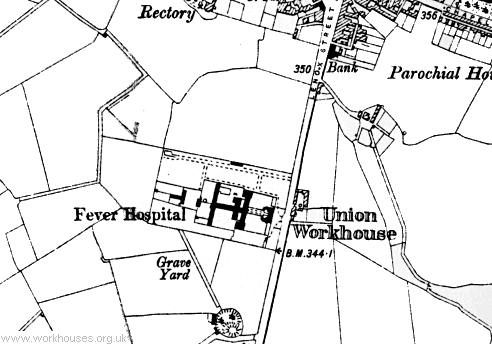
Oldcastle workhouse site, 1913
The buildings followed Wilkinson's typical layout. An entrance and administrative block at the east contained a porter's room and waiting room at the centre with the Guardians' board room on the first floor above.
The main accommodation block had the Master's quarters at the centre, with male and female wings to each side. At the rear, a range of single-storey utility rooms such as bakehouse and washhouse connected through to the infirmary and idiots' wards via a central spine containing the chapel and dining-hall.
During the famine in the mid-1840s, a 44-bed fever hospital was erected at the west of the workhouse. A burial ground lay at the south of the site.
At the end of 1914, the workhouse was taken over as internment camp for German and Austrian men who had been living in Ireland, to prevent them returning home and joining the German military forces. There was also concern that the civilians of enemy nations might engage in spying or sabotage, and generally act as threat to British war interests. The existing workhouse inmates were transferred to the institutions at Bailieborough and Kells. The camp was closed in May, 1918, following a large anti-conscription demonstration at Oldcastle. The prisoners were then moved to Knockaloe Camp on the Isle of Man.
The workhouse premises were restored by the Guardians in 1919 for use as a co-operative store. Howwere, the buildings were burned by the IRA in May 1920 to prevent British soldiers being billeted there. The surviving structures were demolished in the 1950s and a housing development called "The Terrace" built on the site.
Records
Note: many repositories impose a closure period of up to 100 years for records identifying individuals. Before travelling a long distance, always check that the records you want to consult will be available.
- Meath County Library, Railway Street, Navan, Co. Meath. Holdings: Guardians' Minute Books (May 1870 - Oct 1920 with gaps).
Bibliography
- Crossman, V (2006) Politics, Pauperism and Power in Late Nineteenth-century Ireland
- Gray, P (2009) The Making of the Irish Poor Law, 1815-43
- O'Connor, J (1995) The Workhouses of Ireland


Links
- None.
 For US readers
Unless otherwise indicated, this page () is copyright Peter Higginbotham. Contents may not be reproduced without permission.