

Leominster, Herefordshire
Up to 1834
A workhouse existed in Leominster from around 1729 (Hitchcock, 1985). From 1759, it occupied the infirmary section of the ancient priory, to the north-east of the town centre.
In 1776, Shobdon had a workhouse housing up to twenty inmates. Nine were relieved there in 1803.
Kimbolton had a parish workhouse located in what is now the Old Workhouse, to the south of the village.
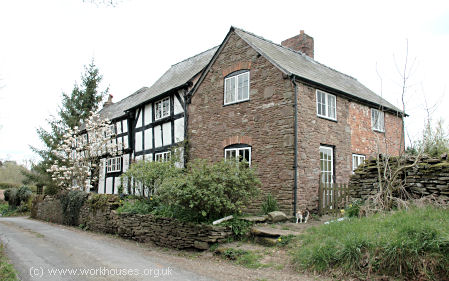
Kimbolton former parish workhouse, 2007.
© Peter Higginbotham.
Kingsland's parish workhouse, still known as The Poorhouse, was located on Longford.
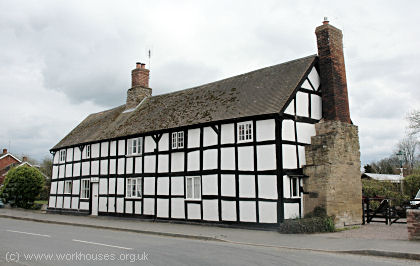
Kingsland former parish workhouse, 2007.
© Peter Higginbotham.
After 1834
Leominster Poor Law Union was formed on 15th June 1836. Its operation was overseen by an elected Board of Guardians, 32 in number, representing its 25 constituent parishes as listed below (figures in brackets indicate numbers of Guardians if more than one):
County of Hereford:
Aymestrey (2), Bodenham (2), Croft, Docklow, Eye, Eyton, Fordsbridge, Hatfield, Hope-under-Dinmore, Humber, Kimbolton, Kingsland (2), Laysters, Leominster Borough (4), Leominster Out Parish (2), Lucton, Luston, Middleton-on-the-Hill, Monkland, Newton, Orleston, Puddlestone, Stoke Prior, Shobdon, Yarpole.
Later Additions: New Hampton (1858), Hampton Wafer (1858).
The population falling within the union at the 1831 census had been 14,730 with parishes ranging in size from Croft and Fordsbridge (population 33 each) to Leominster Borough (4,300). The average annual poor-rate expenditure for the period 1833-35 had been £6,022 or 8s.2d. per head of the population.
A union workhouse was constructed in 1836-8 based around the existing priory establishment. The architect was George Wilkinson, who managed to incorporate the old building into a design that broadly followed the model 'square' plan, with a single-storey entrance block at the west of the complex. The workhouse location and layout are shown on the 1902 map below.
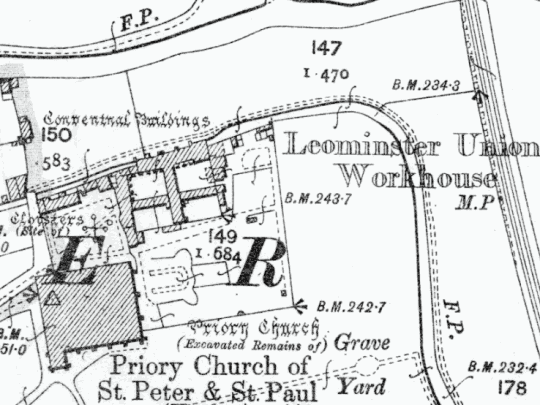
Leominster workhouse site, 1903.
The single-storey entrance block at the west of the workhouse contained the board-room and clerk's office to the south, a waiting hall at the centre, and porter's room and receiving room to the north. To the rear of the entrance block were men's and boys' yards separated by a block in between. Running parallel to the entrance block was the chapel-cum-dining-hall. Female accommodation was to the rear.
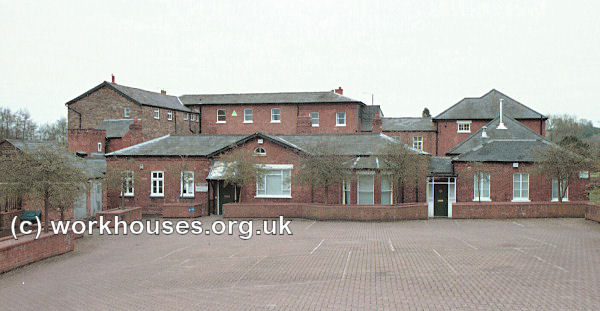
Leominster from the west, 2001.
© Peter Higginbotham.
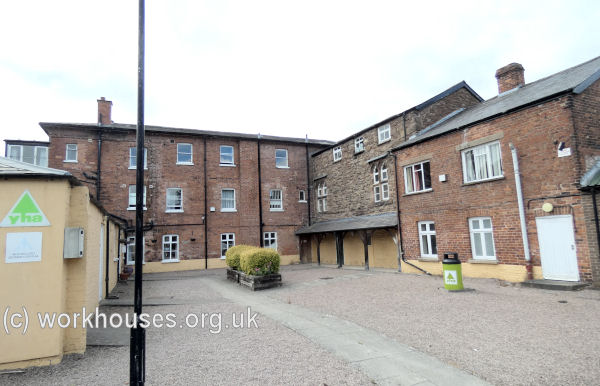
Leominster workhouse female yard from the south, 2001.
© Peter Higginbotham.
The monastic block at the north may have originally be an infirmary. It was adapted for use as day room and dormitory accommodation.
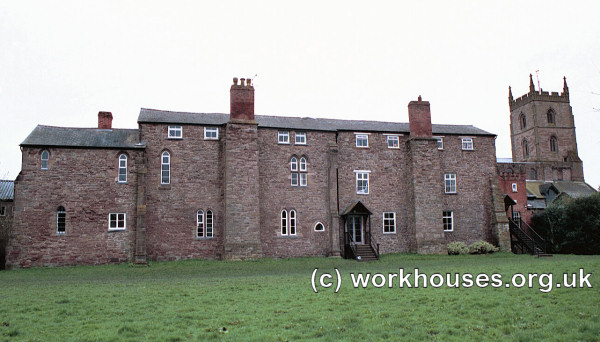
Leominster monastic block from the north, 2001.
© Peter Higginbotham.
The workhouse buildings later became the Old Priory Hospital and then as offices for Herefordshire County Council. In 2001, part of the building was taken over for use as a youth hostel.
Children's Home
By the 1920s, the Leominster Union established a children's home at 46 Etnam Street, Leominster. It later became the council-run Norfolk House Children's Home. The property is now a home for the elderly.
Staff
Inmates
Records
Note: many repositories impose a closure period of up to 100 years for records identifying individuals. Before travelling a long distance, always check that the records you want to consult will be available.
- Herefordshire Archives and Record Centre, Fir Tree Lane, Hereford HR2 6LA. Very few records survive. Holdings include: Guardians' minute books (1852-1930 with gaps); Deeds and plans (1836-41).
Bibliography
- Hitchcock, T.V. (1985) The English workhouse: a study in institutional poor relief in selected counties. l695-l750. (DPhil thesis. University of Oxford.)
Links
- None.
 For US readers
Unless otherwise indicated, this page () is copyright Peter Higginbotham. Contents may not be reproduced without permission.