

East Retford, Nottinghamshire
Up to 1834
A parliamentary report of 1777 recorded parish workhouses in operation at East Retford (for up to 30 inmates), Clarbrough [Clarborough] (60), and Sutton (40).
East Retford was one of several poor law incorporations formed in Nottinghamshire under the terms of Gilbert's Act of 1782. Others included Gedling (1787), Claypole (1817), Thurgarton (1824), Bingham, Blyth, and Clarborough. The East Retford Incorporation established a poorhouse in 1818 and, by 1834, 33 other member parishes were paying between £3 and £10 a year to use it, plus 3s.0d. a week for each pauper in occupancy. The Incorporation's workhouse was located on Grove Street in East Retford, later being converted to a police station.
In 1836, workhouses were in operation at Retford, Clarborough, and Tuxford.
After 1834
The East Retford Incorporation was, in principle, immune from the strictures of the 1834 Act. However, its Guardians were persuaded that the Incorporation should be dissolved and replaced by a new Poor Law Union. The East Retford Poor Law Union formally came into being on 1st July 1836. Its operation was overseen by an elected Board of Guardians, 51 in number, representing its 50 constituent parishes as listed below (figures in brackets indicate numbers of Guardians if more than one):
County of Nottingham:
Askham, Babworth, Barnby Moor, Bevercotes, Bothamsall, Clareborough [Clarborough], Clayworth, Cottam, Darlton, East Drayton, West Drayton, Dunham, Eaton, Elkesley, Everton, Fledborough, Gamston, Gringley-on-the-Hill, Grove, Haughton, Hayton, Headon-cum-Upton, Laneham, North Leverton, South Leverton, Littleborough, Lound, East Markham, West Markham, Markham Clinton, Marnham, Mattersey, Normanton-on-Trent, Ordsall, Ragnall, Rampton, Ranskill, East Retford (2), West Retford, Scaftworth, Scrooby, Stokeham, Sturton, Sutton, Torworth, Treswell, Tuxford, North Wheatley, South Wheatley, Wiseton.
Later Additions: Habblesthorpe (from 1836), North Retford (from 1894).
The population falling within the Union at the 1831 census had been 20,071 with parishes ranging in size from from South Wheatley (population 35) to East Retford itself (2,491). The average annual poor-rate expenditure for the period 1833-35 had been £7,475 or 7s.5d. per head.
A new East Retford Union workhouse for 200 inmates was erected in 1836-38 at the top of Spital Hill in what was then open countryside. It cost about £4,500 and could accommodate 200 inmates. While it was under construction, the union made use of existing workhouses at Retford, Clarborough, and Tuxford. The new building was designed by HJ Whitling who was also the architect of workhouses at Beaminster, Bridport and Kington. His design for East Retford was a variation on the model hexagonal plan published by the Poor Law Commissioners in 1835, and similar to the one used at Beaminster.
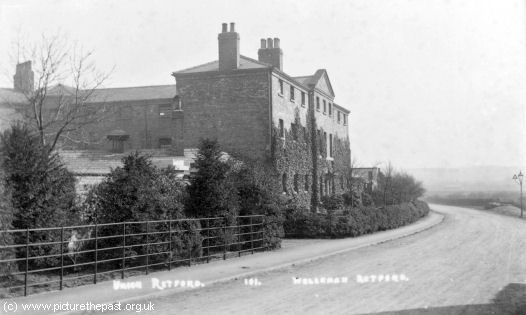
East Retford workhouse from the west, early 1900s.
© Nottinghamshire Local Studies and www.picturethepast.org.uk.
The site location and layout are shown on the 1916 map below.
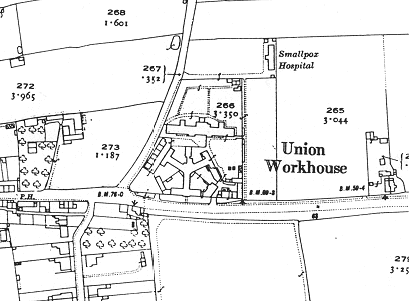
East Retford workhouse site, 1916.
At the end of 1837, the first master and matron were Joseph Cheatter and his wife, both aged 67, and who continued in office until 1857.
The Guardians' minute books record the discipline to which inmates were subjected. In December 1842, John Laver left the workhouse temporarily without permission and was punished by solitary confinement with a meal of 8 ozs. of bread and 1 lb. of cooked potatoes instead of the normal dinner. In June 1842, Maria Williams, who had committed "a gross act of indecency," was punished by confinement and a diet of cooked potatoes. In 1841 Mary Dunk, who was guilty of indecently exposing her person, was ordered to have bread and water on the next three days that inmates had meat. A different punishment was given in April, 1839, to Selina Hill who had conducted herself in a way which was very unbecoming to her sex, by allowing another inmate to have "very improper connections with her." She was ordered to have her hair cut short, and not to be allowed to wear a cap for three months.
After 1930, the workhouse became East Retford Public Assistance Institution. After the introduction of the National Health Service in 1948, it was called Hillcrest Hospital and provided care for the elderly until its closure and demolition in the 1970s.
Christopher Morley has kindly contributed his memories of the latter years of the institution:
I have very fond memories of this place as my parents, Mr. John Morley and Mrs. Phyllis Morley, were probably the very last matron and superintendant. I was living at Hillcrest with my parents from 1959 until 1970 but they were there until its closure in the early 70's. My parents then retired to, firstly Gamston and then to North Norfolk. The matron and superintendant's living quarters were in the middle of the three wings. All rooms were 6 sided!
At this time it was a home for the aged and infirm. It did have its own small hospital ward but major cases were treated at Retford or Worksop hospital. However, small operations could be undertaken on the ward in a mini operation room. Attached to the main building was a reasonably large mortuary with a direct (discreet)entrance from Leverton Road. The old isolation house (large wooden building) which they called the 'smallpox hospital' at the Claters Close end, was still to be seen.
Rooms were also available in a building at the rear where 'Part Three' family accommodation was available for the homeless.
I remember well the extensive gardens at the rear and the lovely garden. At this time, the old stone breaking sheds could still be seen, complete with rings on the walls where I presume the inmates were chained in order to break stone or chop wood for the upkeep.
Every Christmas Day the Mayor of East Retford would visit Hillcrest and meet the elderly.
Staff
Inmates
Records
Note: many repositories impose a closure period of up to 100 years for records identifying individuals. Before travelling a long distance, always check that the records you want to consult will be available.
- Nottinghamshire Archives and Southwell Diocesan Record Office, County House, Castle Meadow Road, Nottingham NG2 1AG. Relatively few records survive. Holdings include: Guardians' minute books (1836-1930); Vaccination registers (1871-1919); etc.
Bibliography
- In the Shadow of the Workhouse by Maurice Caplan (1984)
- The Book of Retford by James Joffey (1991, Barracuda Books).
- The Early Days of Retford Workhouse by Dorinda Clark (1969, Eaton Hall College of Education).
Links
- None.
Acknowledgment
- Archive picture is by kind permission of www.picturethepast.org.uk and Nottinghamshire Local Studies.
 For US readers
Unless otherwise indicated, this page () is copyright Peter Higginbotham. Contents may not be reproduced without permission.