

Weobley, Herefordshire
Up to 1834
A parliamentary report of 1777 recorded parish workhouses in operation at Dilwyn for up to 20 inmates, and at Eardisland for up to 15. A workhouse existed at the west side of Woonton, near Almeley, where a garage is now located.
After 1834
Weobley Poor Law Union was formed on 9th April 1836. Its operation was overseen by an elected Board of Guardians, 24 in number, representing its 21 constituent parishes as listed below (figures in brackets indicate numbers of Guardians if more than one):
County of Hereford:
Almeley, Birley, Bishopstone, Bridge Sollers, Brinsop, Brobury, Byford, Dilwyn (2), Eardisland (2), Kimmersley, Mansell Gamage, Mansell Lacy, Monnington, Norton Canon, Canon Pyon, King's Pyon, Sarnesfield, Stretford, Weobley (2), Wormsley, Yazor.
The population falling within the union at the 1831 census had been 6,938 with parishes ranging in size from Stretford (population 44) to Dilwyn (1,035) and Weobley itself (819). The average annual poor-rate expenditure for the period 1833-35 had been £3,808 or 11s.0d per head of the population.
A new union workhouse for 80 inmates was built in 1836-37 to the north-west of Weobley, for which the Poor Law Commissioners authorized an an expenditure of £3,000. The architect was George Wilkinson who was responsible for other Herefordshire workhouses at Leominster, Ledbury and Bromyard. His design followed the popular cruciform or "square" plan with an entrance block at the front, behind which lay the four accommodation wings radiating from a central hub, creating yards for the different classes of pauper (male/female, old/young). The workhouse location and layout are shown on the 1902 map below.
The first Master of the workhouse William Heathcote, with his wife Jane Frances Heathcote as Matron. They took up their positions on 21st August 1837 and lived in the workhouse with some of their 12 children. The following year, William died at the workhouse aged 45 and was buiried on 4th November, 1838. His wife Jane may have stayed on for some time as her two youngest children, Jesse and Emma, also died at the workhouse, one in January and the other early February, 1839.
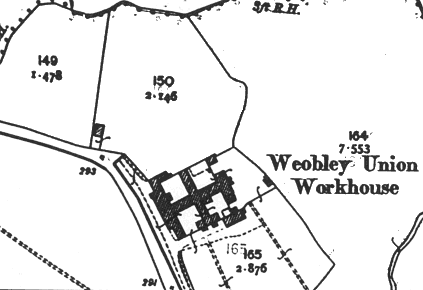
Weobley workhouse site, 1902.
The main later addition to the original buildings was in 1874 when the Guardians were authorized to spend £900 on the erection of sick wards at the south-east of the site.
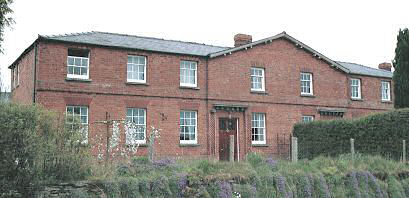
Former Weobley workhouse entrance block from the west, 2001.
© Peter Higginbotham.
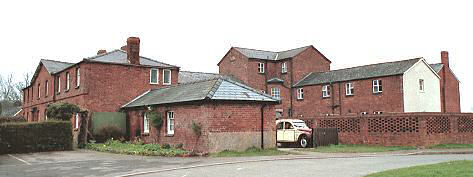
Former Weobley workhouse general view from the south, 2001.
© Peter Higginbotham.
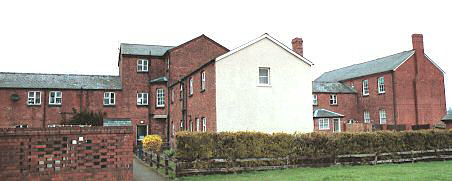
Former Weobley workhouse from the south-east, 2001.
© Peter Higginbotham.
After 1930, the workhouse was redesignated as a Public Assistance Institution. The site later became known as Whitehill House and housed offices for the Weobley Rural District Council. The buildings have now been converted for residential use.
Staff
Inmates
Records
Note: many repositories impose a closure period of up to 100 years for records identifying individuals. Before travelling a long distance, always check that the records you want to consult will be available.
- Herefordshire Archives and Record Centre, Fir Tree Lane, Hereford HR2 6LA. Virtually no local records survive apart from Guardians' minute books (1834-98, with gaps).
Bibliography
- Higginbotham, Peter The Workhouse Encyclopedia (2014, The History Press)
Links
- None.
 For US readers
Unless otherwise indicated, this page () is copyright Peter Higginbotham. Contents may not be reproduced without permission.