


Tendring, Essex
Up to 1834
A parliamentary report of 1777 recorded parish workhouses in operation at Ardleigh (for up to 40 inmates), Beaumont with Mose (14), Little Bentley (26), Bradfield (12), Great Bromley (30), Great Clacton (30), Harwich—Dover Court (8), Harwich—St Nicholas (60), Kirby (24), Lawford (22), Great Oakley (20), Ramsey (14), Tendring (20), Thorpe (50), and Wix (25).
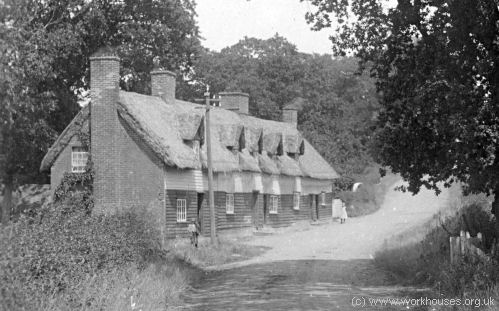
Tendring former parish workhouse, c.1910.
© Peter Higginbotham.
Harwich had a parish workhouse from 1669 on Cow Lane. Great Clacton's workhouse was on the site of what is now 241 Old Road, its position indicated on the 1876 map below.
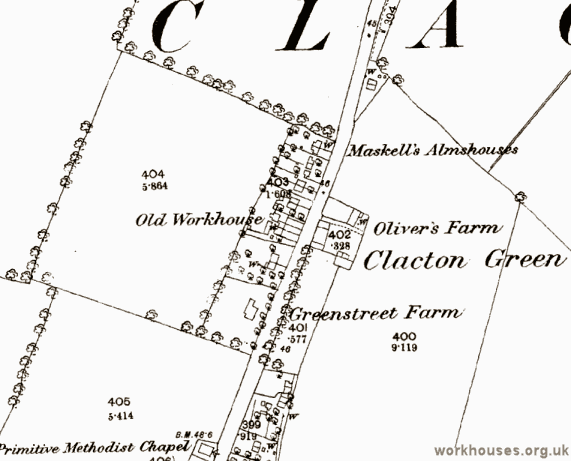
Claction parish workhouse site, c.1876.
After 1834
Tendring Poor Law Union was formed on 16th November 1835. Its operation was overseen by an elected Board of Guardians, 35 in number, representing its 30 constituent parishes as listed below (figures in brackets indicate numbers of Guardians if more than one):
Essex:
Alresford, Ardleigh (2), Great Bentley, Little Bentley, Beaumont-with-Moze, Bradfield, Great Bromley, Little Bromley, Great Clacton, Little Clacton, Elmstead, Frating, Frinton, Great Holland, Little Holland, Kirby, Lawford, Manningtree (2), Mistley (2), Great Oakley, Little Oakley, Ramsey, St Osyth (2), Tendring, Thorpe-le-Soken (2), Thorrington, Walton-le-Soken, Weeley, Wix, Wrabness.
Later Additions: Brightlingsea (1838-1880), Dovercourt (1838-1925), Harwich (1925-1930), Harwich St Nicholas (1838-1925).
The population falling within the union at the 1831 census had been 21,002 - ranging from Frinton (population 35) to Thorpe-le-Soken (1,173) with Tendring itself having a population of 758. The average annual poor-rate expenditure for the period 1833-35 had been £17,850.
The new workhouse was built in to a design by Scott and Moffatt, who also designed many other workhouses including Bedminster, Windsor, and the nearby Billericay. The building, for 300 inmates, was erected in 1837-8 on a site at Tending Heath and cost around £12,000. Its location and layout can be seen on the 1880s map below.
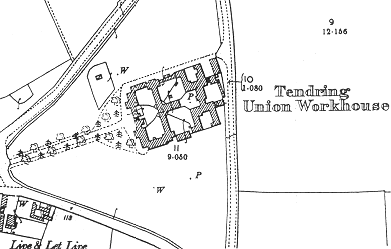
Tendring workhouse site, c.1875.
A single-storey entrance block faced west. Behind this, the wings of three-storey main block emanate from a central hub.
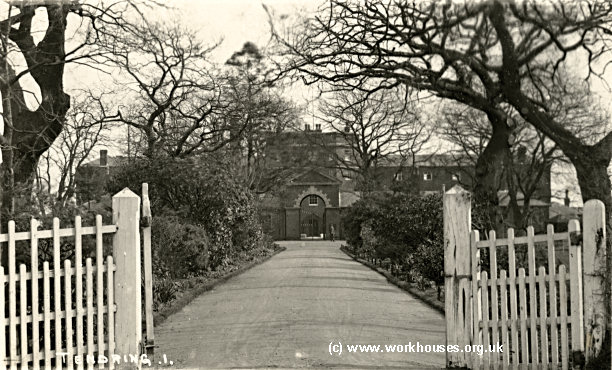
Tendring entrance from west, c.1914.
© Peter Higginbotham.
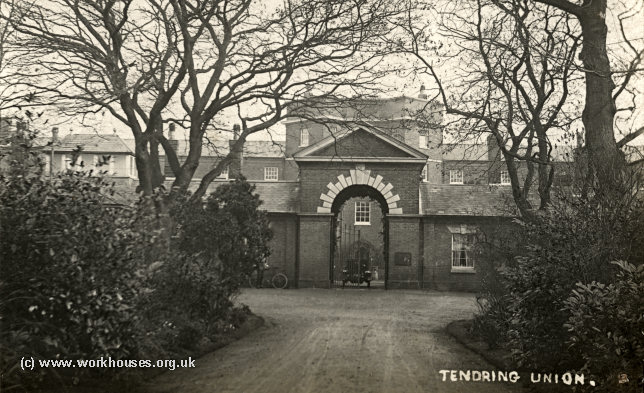
Tendring entrance from west, c.1914.
© Peter Higginbotham.
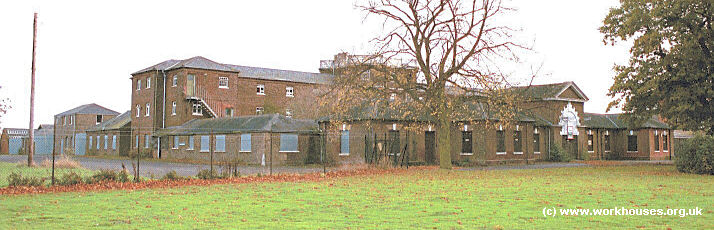
Tendring general view from north-west, 2000.
© Peter Higginbotham.
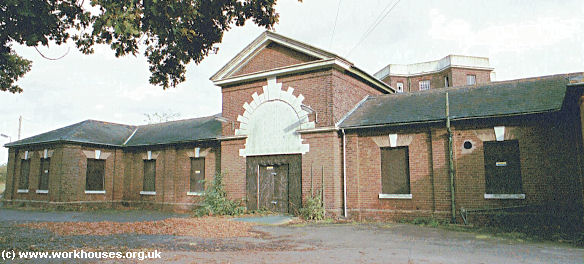
Tendring entrance block from south, 2000.
© Peter Higginbotham.
Later additions to the site include a 94-bed infirmary at the south-east and a nurses' home which were erected in 1901 at a cost of £12,800.
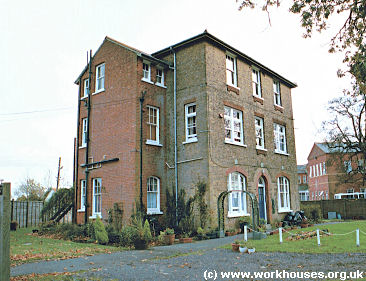
Tendring nurses' home with infirmary behind, 2000.
© Peter Higginbotham.
In December 1908, the workhouse inmates were given a taste of the new cinematograph as reported by a local newspaper:
The cinematograph was in the capable hands of Mr. James, and the incidental music was played by Mr. Davis. The entertainment was a huge success.
Mr. Davis generously provided each old man with a gift of tobacco, each old lady with fruit and each child with sweets.
The workhouse later became Heath Hospital for the Chronic Sick, and then Tendring Meadows Nursing and Residential Home.
Cottage Homes
By 1920, a pair of children's cottage homes known as 'The Firs' and 'The Limes' had been erected on Heath Road a short distance to the south of the workhouse.
The former 'Firs and Limes' cottage homes.
In 1930, the running of the homes was taken over by Essex County Council who erected another pair of cottage homes known as 'The Oaks' and 'The Chestnuts', just to the north of 'The Firs' and 'The Limes'. The 'Oaks' side housed the girls, and the 'Chestnuts' side the boys. In the 1950s, the staff 'aunts' at the homes included Doris Howard, and Ann and Mary Richardson. In 1963, the property was sold off and became the Springbank care home which still occupies the premises.
The former 'Oaks and Chestnuts' cottage homes.
Staff
Inmates
Records
Note: many repositories impose a closure period of up to 100 years for records identifying individuals. Before travelling a long distance, always check that the records you want to consult will be available.
- Essex Record Office, Wharf Road Chelmsford CM2 6YT. Holdings include: Births (1839-1930); Baptisms (1907-30); Deaths (1839-1930); Creed registers (1889-1930) ; etc.
Bibliography
- Higginbotham, Peter The Workhouse Encyclopedia (2014, The History Press)
Links
- None.
 For US readers
Unless otherwise indicated, this page () is copyright Peter Higginbotham. Contents may not be reproduced without permission.