

Milton (Milton Regis), Kent
Up to 1834
A parliamentary report of 1777 recorded parish workhouses in operation at Bordern (with accommodation for up to 8 inmates), Hartlip (10), Iwade (4), Milton (40), Rainham (20), and Sittingborne (25).
A pair of cottages on The Street in Borden once served as the parish workhouse.
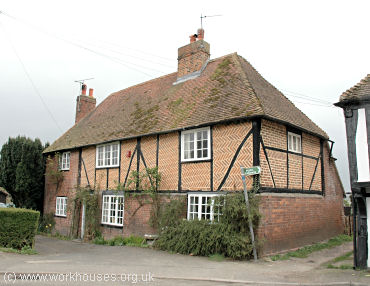
Borden former parish workhouse, 2005.
© Peter Higginbotham.
In Bredgar, a house on Swanton Street dating from 1579 was for a while used as the parish workhouse.
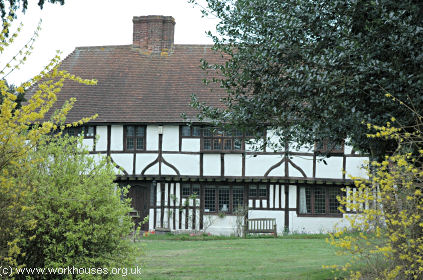
Bredgar former parish workhouse, 2005.
© Peter Higginbotham.
After 1834
The Milton (sometimes known as Milton Regis) Poor Law Union officially came into existence on 25th March 1835. Its operation was overseen by an elected Board of Guardians, 20 in number, representing its 18 constituent parishes as listed below (figures in brackets indicate numbers of Guardians if more than one):
County of Kent: Bapchild, Bobbing, Borden, Bredgar, Lower Halstow, Hartlip, Iwade, Kingsdown, Milstead [Milsted] , Milton (2), Murston, Newington, Rainham, Rodmersham, Sittingbourne (2), Tong, Tunstall, Upchurch.
The population falling within the Union at the 1831 census had been 10,689 with parishes ranging in size from from Kingsdown (population 94) to Milton itself (2,233). The average annual poor-rate expenditure for the period 1831-4 had been £11,179 or £1.0s.11d. per head of the population.
In May, 1835, there were a number of disturbances in various parts of the union caused by angry paupers who were upset as a result of a reduction in their previous allowances. Members of the Board of Guardians were barracked and stoned, eventually requiring the intervention of police and troops.
The Milton Union workhouse was erected in 1836 at a site to the north of Sittingbourne. The design, by William Bland, a member of the Board of Guardians, was an adaptation of the courtyard plan devised by Assistant Poor Law Commissioner Sir Francis Head. This type of layout, in which an outer perimeter of buildings enclosed a large inner courtyard, was employed by a number of Kent Unions including Blean, Bridge, Eastry, East Ashford, Hoo and Maidstone. In 1835, the Poor Law Commissioners authorised an expenditure of £5,342 on construction of the building which was to accommodate 500 inmates. The workhouse location and layout are shown on the 1870 map:
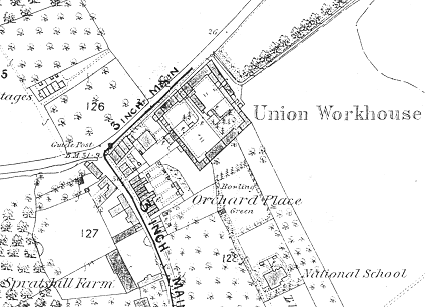
Milton workhouse site, 1870.
In 1874, an infectious diseases hospital was erected at the north-east of the workhouse. It was converted into an infirmary in 1883. In 1887, a two-storey block was built in the central courtyard housing a new dining hall, kitchen and laundry, with men's dormitories on the upper floor.
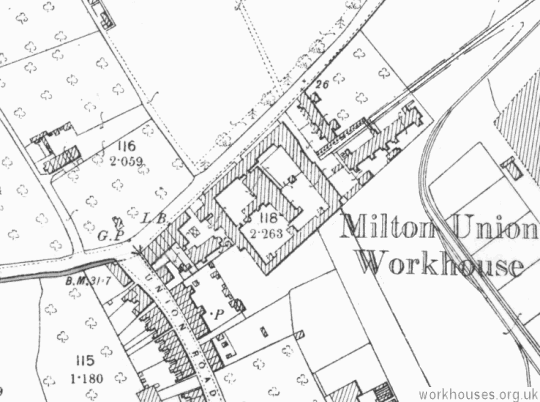
Milton workhouse site, 1913.
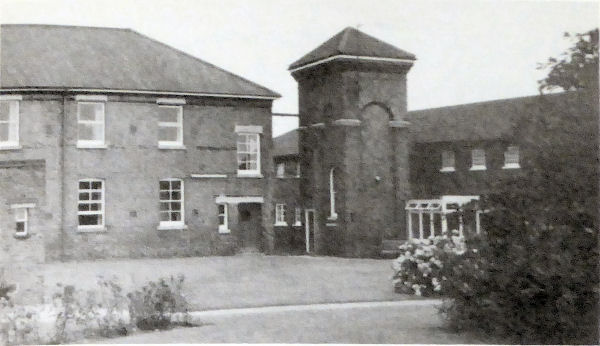
Milton workhouse 1887 block from the south-west.
The former workhouse buildings were demolished in around 1994 and a housing estate erected on the site.
Children's Homes
In around 1905, the Milton Union established a home for up 62 girls at Church House, North Street, Milton Regis. The building later became Green Porch children's home. It has now been converted to offices.
In 1914, a home for up to 45 boys was opened at Langley House, Brewery Road, Milton Regis. The building no longer exists.
Staff
Inmates
Records
Note: many repositories impose a closure period of up to 100 years for records identifying individuals. Before travelling a long distance, always check that the records you want to consult will be available.
- Kent History and Library Centre, James Whatman Way, Maidstone, Kent ME14 1LQ Holdings include: Guardians' minutes (1835-1930); Admissions and discharges (1835-1932); Births (1866-1912); Deaths (1893-1936); Creed register (1888-1914); Register of children in institution (1914-24); Addresses of friends of paupers (1902-28); Vaccination registers (1853-1929); etc.
Bibliography
- Higginbotham, Peter Workhouses of London and the South East (2019)
- Allinson, Helen (2005) Life in the Workhouse — The Story of the Milton Union, Kent. (SynJon Books). A very readable account of the Milton Union workhouse and life behind its doors. [Book costs £10 (P+P - UK:£1, elsewhere £3.15) from SynJon Books (Dept INT), 5 Homestead View, The Street, Borden, Kent ME9 8JQ (tel 01327-342739) or via SynJon Books website]
Links
- None.
 For US readers
Unless otherwise indicated, this page () is copyright Peter Higginbotham. Contents may not be reproduced without permission.