

Hemel Hempstead, Hertfordshire
Up to 1834
On the 24th May 1720, the Hemel Hempstead Vestry contracted Matthew Marryott:
A parliamentary report of 1777 recorded parish workhouses in operation at Flampstead (for up to 30 inmates), Great Gaddesden (30), Hemel Hempstead (60), and King's Langley (30).
After 1834
Hemel Hempstead Poor Law Union was formed on 12th June 1835. Its operation was overseen by an elected Board of Guardians, 14 in number, representing its 6 constituent parishes as listed below (figures in brackets indicate numbers of Guardians if more than one):
County of Hertford:
Bovingdon (2), Flamstead (2), Flaunden, Great Gaddesden (2), Hemel Hempstead (5), King's Langley.
Later Addition: Markyate (1897).
The population falling within the Union at the 1831 census had been 9,910 — with parishes ranging in size from Flaunden (population 316) to Hemel Hempstead itself (4,759). The average annual poor-rate expenditure for the period 1832-35 had been £5,672 or 11s.5d. per head of the population.
A new Hemel Hempstead Union workhouse was erected in 1835-6 at the east side of Redbourn Road (now Allandale) in Hemel Hempstead. In 1835, the Poor Law Commissioners authorised an expenditure of £3,450 on construction of the building which was to accommodate 200 inmates. It was designed by John Griffin who was also the architect of the Union workhouses at Barnet and St Albans. The workhouse's location and layout are shown on the 1878 and 1897 maps below.
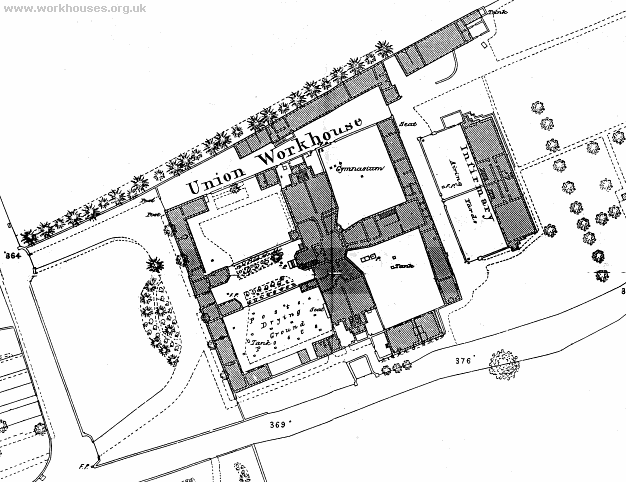
Hemel Hempstead Site, 1878.
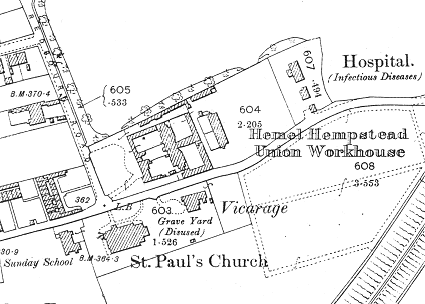
Hemel Hempstead Site, 1897.
Although the workhouse bore a certain resemblance to the Poor Law Commissioners model "square" plan, it had a T-shaped main building rather than the cruciform layout normally associated with the square plan. The surrounding entrance and outbuildings were probably single storeyed. Women were housed at the south of the site (note the Drying Ground for laundry on the 1878 map) and men at the north (note the Gymnasium). A separate 40-bed infirmary was built at the rear of the workhouse in 1869. It was probably a two storey building and had separate sections for male and female patients. By the 1890s, the eastern end of the site was occupied by an isolation hospital for the treatment of infectious diseases with its own entrance from Highfield Lane (now Queensway).
After 1930, the workhouse passed into the control of Hertfordshire County Council and became Hempstead House Public Assistance Institution. At the start of the Second World War, temporary ward blocks were erected at the north of the workhouse as part of the Emergency Medical Service. The map below shows the site in around 1947.
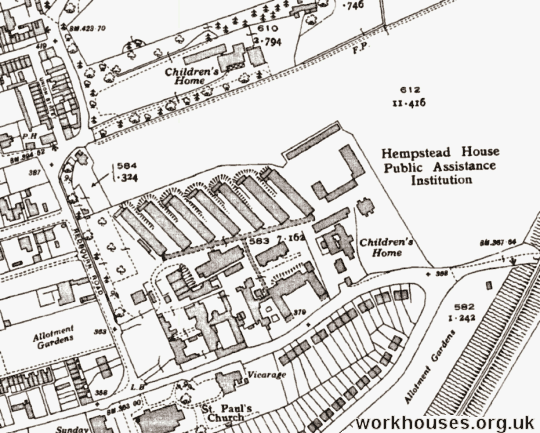
Hemel Hempstead Site, c.1947.
In 1948, the institution joined the National Health Service in 1948 as St Paul's Hospital which served as a maternity hospital for the town. The buildings have now all been demolished.
Children's Homes
By the 1920s, the isolation hospital building had been extended and converted into a children's home. The 1947 map above also shows a second children's home immediately to the north of the workhouse site in a property formerly known as East Lodge.
Records
Note: many repositories impose a closure period of up to 100 years for records identifying individuals. Before travelling a long distance, always check that the records you want to consult will be available.
- Hertfordshire Archives and Local Studies, County Hall, Pegs Lane, Hertford SG13 8DE. The few surviving holdings include: Guardians' minute books (1838-1921, 1924-30); Staff service register (1876-1930); etc.
Staff
Inmates
Bibliography
- An Account of Several Work-houses for Employing and Maintaining the Poor. Anon, 1725.
- Gutchen RM, Truwert E, and Peters G (1984) Down and Out in Hertfordshire — A Symposium on the Old and New Poor Law (Hertfordshire Publications)
Links
- None.
 For US readers
Unless otherwise indicated, this page () is copyright Peter Higginbotham. Contents may not be reproduced without permission.