


Carmarthen, Carmarthenshire
Up to 1834
In 1758, Carmarthen began renting part of the Old Priory for use as a poorhouse. In 1799, the vestry decided to erect a new poorhouse at 'Waundew Common'. It proved an expensive project, leaving the parish with debts of around £1,400 by the time it opened in 1805.
In 1777, Laugharne had a workhouse for up to six inmates. The following year, a workhouse was established at Llangendeirne where 'all whom refuse to come in shall not be entitled to any relief.' Poorhouses were also opened by Llanartheny and, in 1796, by Newchurch.
After 1834
Carmarthen Poor Law Union was formed on 2nd July, 1836. Its operation was overseen by an elected Board of Guardians, 32 in number, representing its 28 constituent parishes as listed below (figures in brackets indicate numbers of Guardians if more than one):
County of Carmarthen:
Abergwilly (2), Abernant, Carmarthen (4), Conwil-in-Elfet, Laugharne, Laugharne township, Llanarthney, Llandawk [Llandawke], Llanddarog, Llandefeilog, Llandilo-Abercowin, Llandowror, Llanvihangel-Abercowin, Llangain, Llangendeirne, Llangynnin, Llangunnock, Llangynon, Llanllawddog, Llanpumpsaint, Llansadurnen, Llanstephan, Merthyr, Mydrim, Newchurch, St Clears, St Ishmaels, Treleach-ar-Bettws.
Later Additions: Castle Green, Llangunnor.
The population falling within the union at the 1831 census had been 35,944 with parishes ranging in size from Llandawk (population 19) to Carmarthen itself (9,995). The average annual poor-rate expenditure for the period 1833-35 had been £14,283 or 7s.11d. per head.
In October 1836, tenders were sought for the enlarging of the the 1805 building, at the wests side of what is now Penlan Road (SN411206). The gatehouse was retained from the earlier building and in 1845 a register office was added at its south side. Following the enlargement, the two-storey main building had a double-courtyard layout. The workhouse capacity was then set at 260 places. The workhouse location and layout are shown on the 1906 map below.
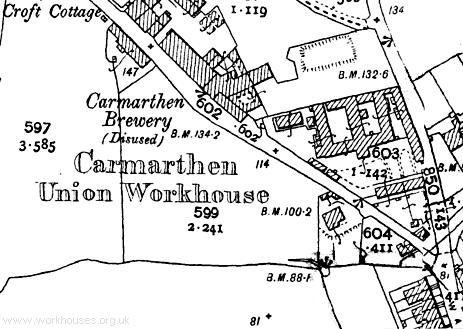
Carmarthen workhouse site, 1906.
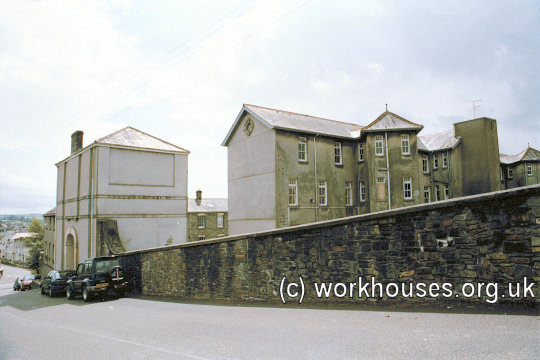
Carmarthen workhouse general view from the north-east, 2000.
© Peter Higginbotham.
A two-storey entrance block containing an entrance archway was located at the east of the site on Penlan Road.
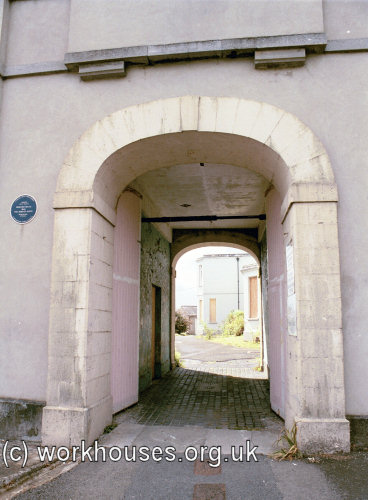
Carmarthen workhouse entrance from the east, 2000.
© Peter Higginbotham.
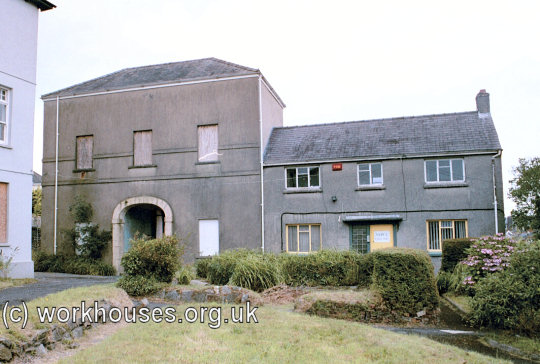
Carmarthen workhouse rear of gatehouse and register office block from the west, 2000.
© Peter Higginbotham.
On the 19th June, 1843, the workhouse was stormed by the "Rebecca Rioters" who, in 1842-43, carried out a campaign of protests across South Wales, mainly against the high charges at the toll-gates on the public roads. The rioters took their name from the Book of Genesis (Chapter 24, Verse 60): "And they blessed Rebekah and said unto her, Thou art our sister, be thou the mother of thousands of millions, and let thy seed possess the gate of those which hate them." The rioters often included one or more "Rebecca" figures dressed in women's clothes and wearing a wig of ringlets.
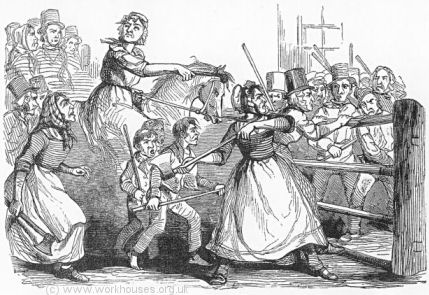
Rebecca rioters, 1843.
© Peter Higginbotham.
On the day in question, protestors entered Carmarthen to lay their grievances before magistrates. However, possibly diverted by local unruly elements, a large crowd arrived at the workhouse where the matron was forced to hand over her keys. The mob then rushed into the courtyard and then entered the buildings where they smashed furniture and broke windows. The riot continued until the arrival of the 4th Light Dragoons who brought proceedings until control and took sixty prisoners.
In 1879, a new two-storey block housing forty-six children was erected at the south of the workhouse. It was designed by George Morgan.
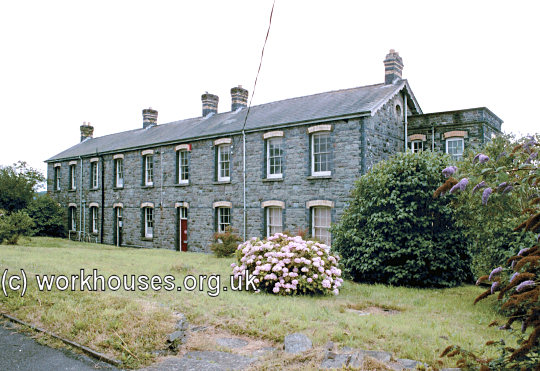
Carmarthen workhouse children's block, 2000.
© Peter Higginbotham.
On the afternoon of 20 March 1906, a fire broke out in the master and matron's quarters in the main building of the workhouse. It was said to have been caused by an imbecile pauper stirring the fire during the temporary absence of the matron. The fire brigade quickly arrived and the inmates were moved to the children's and other blocks of buildings, with no casualties occurring. The adults' accommodation, including the sick wards, and the master and matron's residence were completely gutted. At the time, there were 103 inmates in residence, including children and 20 certified imbeciles.
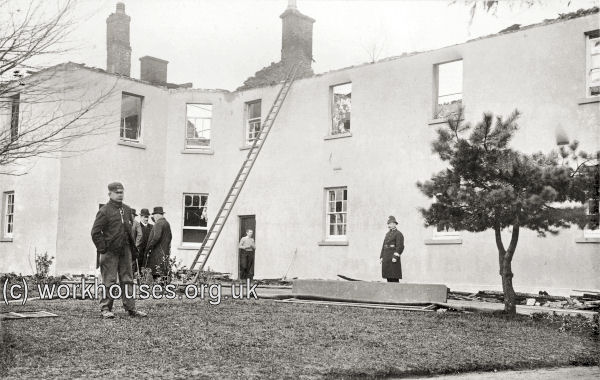
Carmarthen workhouse main block from the south-east following the fire, 1906
© Peter Higginbotham.
The main block was rebuilt in 1908 at a cost of around £9,000. The new building was three storeys high with a T-shaped layout.
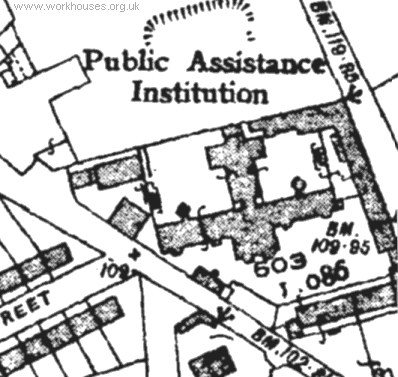
Carmarthen workhouse site, 1936.
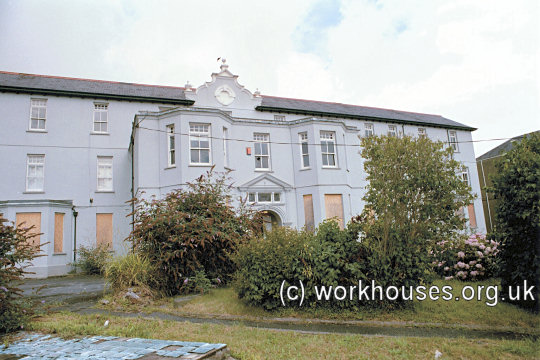
Carmarthen new main building from the south, 2000.
© Peter Higginbotham.
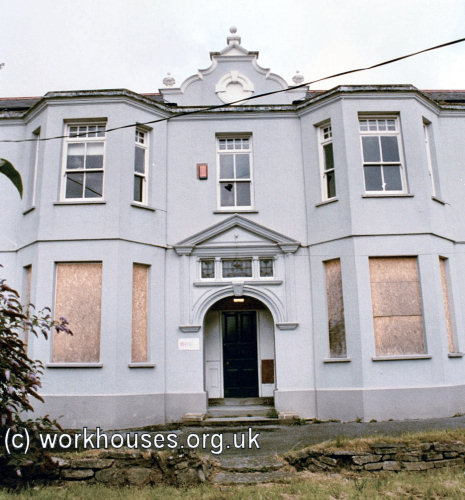
Carmarthen workhouse main building entrance, 2000.
© Peter Higginbotham.
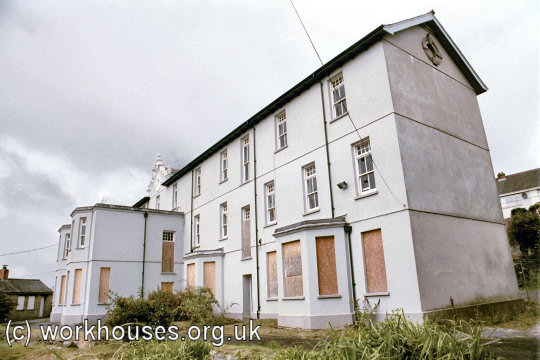
Carmarthen workhouse main building from the south-east, 2000.
© Peter Higginbotham.
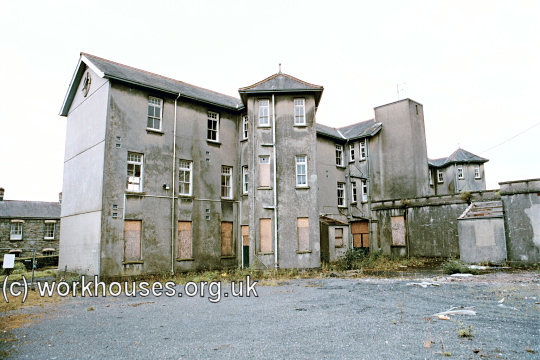
Carmarthen workhouse main building from the north-east, 2000.
© Peter Higginbotham.
A small building nearby may have been an isolation ward for infectious cases.
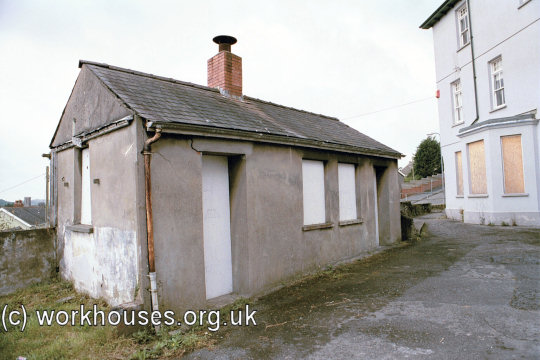
Carmarthen workhouse infectious block, 2000.
© Peter Higginbotham.
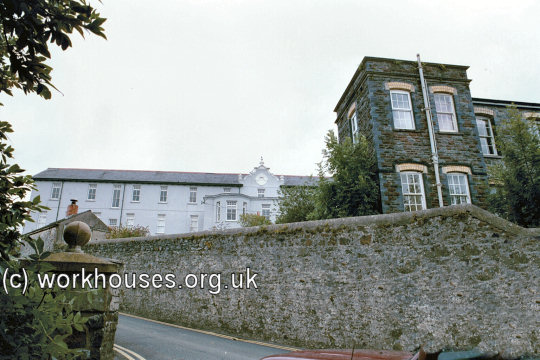
Carmarthen workhouse from the south-west, 2000.
© Peter Higginbotham.
From 1905, to protect them from disadvantage in later life, the birth certificates for those born in the workhouse gave its address just as 1 Penlan Road, Carmarthen.
During the First World War, the workhouse was used as an Auxiliary Military Red Cross Hospital. Troops were also quartered there during the Second World War.
After 1930, the workhouse became a Public Assistance Institution. At some time around then, the main building was modernised with the removal of the east and west ranges, the addition of sanitary towers at the rear of the building, and the remodeling of the entrance.
The site later housed the offices of the local education authority. In 2000, a few of the former workhouse buildings were still occupied by charitable organisations, but the majority of the site was becoming derelict. In March 2018, a fire caused significant damage to the surviving infirmary block.
Children's Home
By 1920, the Carmarthen Union was running a children's cottage home known as Waterloo Cottage. In 1924, the home could accommodate 15 children, with Jane Evans as its Superintendent. The property, located off Waterloo Terrace to the south of the workhouse, is now known as LLwyn Martin.
By 1929, the home had moved to new premises at 'Ystradwrallt' on Station Road, Nantgaredig.
Staff
- 1895 — Master: Edwin Price; Matron: Miss Margaret Price.
- 1881 Census
Inmates
Records
Note: many repositories impose a closure period of up to 100 years for records identifying individuals. Before travelling a long distance, always check that the records you want to consult will be available.
- Carmarthenshire Archives, Carmarthen Library, St Peter's Street, Carmarthen SA31 1LN. Sole holdings appear to be: Guardians' minute books (1927-30); Ledgers (1917-30).
Bibliography
- Higginbotham, Peter The Workhouse Encyclopedia (2014, The History Press)
- NEW! Workhouses of Wales and the Welsh Borders. The story of the workhouse across the whole of Wales and the border counties of Cheshire, Gloucestershire, Herefordshire and Shropshire. More...
Links
 For US readers
Unless otherwise indicated, this page () is copyright Peter Higginbotham. Contents may not be reproduced without permission.