

West London
Up to 1834
The pre-1834 operation of the poor law and workhouses in the City of London is described in two separate pages on:
After 1834
West London Poor Law Union formally came into existence on 13th December 1837. Its operation was overseen by an elected Board of Guardians, 20 in number, representing representing its 7 constituent parishes as follows (figures in brackets indicate numbers of Guardians if more than one): Bridewell precinct; St Andrew, Lower or City Liberty (4); St Bartholomew the Great (2); St Bartholomew the Less; St Bride's, otherwise St Bridget, Fleet Street (5); St Dunstan's West (2); St Sepulchre, Newgate (5).
The population falling within the new Union at the 1831 census had been 27,825 with parishes ranging in size from Bridewell precinct (population 456) to St Sepulchre, Newgate(7,710). The average annual poor-rate expenditure for the period 1834-36 had been £17,522 or 12s.7d. per head of the population.
Initially, the union took over two former parish workhouses. That of St Sepulchre Newgate, on West Street, near Smithfield Market, was used for males, while that of St Bride, on Shoe Lane, housed females. Following enlargement of the West Street premises in 1840, the females were transferred there and Shoe Lane was closed. The location of the West Street workhouse is shown on the 1862 map below.
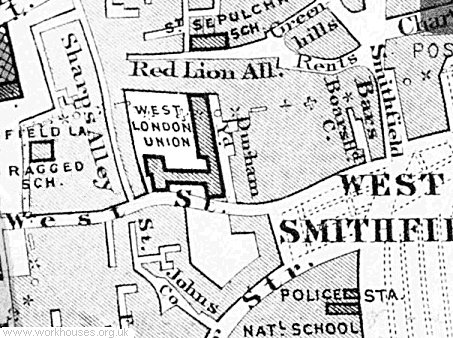
West London Union workhouse site, c.1862.
In 1848, a parliamentary survey of the workhouse provision for vagrants included a survey of the individual vagrants being accommodated at the West London workhouse on a number of days in March 1848. A typical day's entry is shown below:
| Tuesday, March 7, 1848. | |||||
|---|---|---|---|---|---|
| Name. | Age. | Married or Single. | No. of Children. | Where from. | Remarks. |
Ann Dawson | 39 | Widow | 3 | Essex | Cadger, been here many times. |
Susan Dawson | 16 | Single | .. | " | Ditto |
Bridget Brady | 44 | " | .. | Mayo | Ditto |
Mary Carty | 24 | " | .. | Cork | Ditto |
Eliza Fannigan | 15 | " | .. | Galway | Ditto |
Mary Collins | 30 | " | .. | Cork | Ditto |
Mary Brown | 49 | Widow | .. | Seacole Lane | Cadger, been here before. |
Margaret Lewis | 32 | Married | .. | Guernsey | Charwoman, out of employ. |
Ellen Crawley | 29 | Single | .. | Skibbereen | Cadger, sleeping in diferent refuges. |
Nancy Crawley | 12 | " | .. | Cork | Ditto |
Joseph Carter | 19 | " | .. | Chatham | Cadging on her way home. |
John Harris | 23 | " | .. | Hertford | Shoemaker, seeking employ. |
Mary Donovan | 23 | " | .. | Cork | Cadger, sleeping in different refuges. |
Johanna Neil | 33 | Married | 1 | " | Ditto |
Mary Neil | 7 | . . | .. | " | Ditto |
George Harris | 20 | Single | .. | Shropshire | Ditto |
Isaac Twithet | 24 | " | .. | Great Berkhamstead | Labourer, seeking employ. |
George Wood | 17 | " | .. | Sussex | Cadger, seeking employ. |
Pat Robson | 32 | " | .. | New Castleton | Travelling draper. |
James Davis | 15 | " | .. | Somersetshire | Cadger, sleeping in different refuges. |
Maria Hellen | 20 | " | .. | Gosport | Needle-woman, seeking employ, by P.C.254, 1½ |
Elizabeth Griffiths | 38 | Married | .. | Buckinghamshire | Servant, out of employ. P.C.260, 2½ |
22 | GEORGE JERRARD, Porter. | ||||
In February 1857, the Lord Mayor of London made an unannounced visit to the West London workhouse casual ward, as part of a series of such inspections. The Mayor, together with the Recorder and the City Architect, arrived at the union's workhouse, only to be told that the casual ward was some two-and-a-half miles away at Battle Bridge. Like any applicants for accommodation at the casual ward, the mayor and his party then had to make their way through the city's streets to reach their final destination. They found that the men's accommodation conisted of a twelve-stall stable. Their report noted:
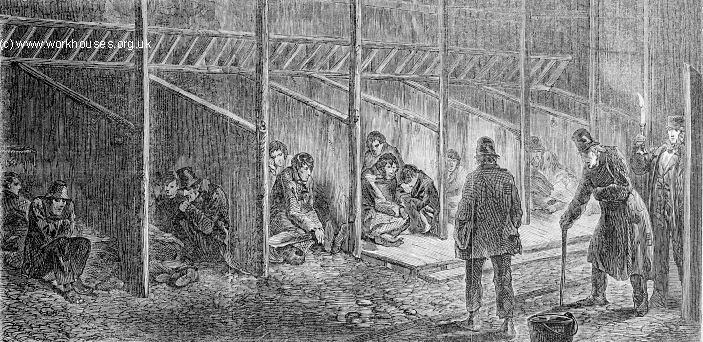
West London workhouse men's casual ward, 1857.

West London workhouse women's casual ward, 1857.
Edmonton Union School
The West London Union operated a separate Union School, sometimes referred to as its 'children's workhouse', at Edmonton. It was located at the south side of Meeting House Lane (later Bridport Road and Church Road) which ran from the west side of Upper Fore Street. In 1849, the establishment was said to house up to 150 children.
The Cornwallis Road Workhouse
In 1864-65, the union erected a new workhouse for 500 inmates at the west side of Shadwell Road (now Cornwallis Road) in Upper Holloway. The official opening of the establishment was carried out by the Chairman of the Guardians, Mr S.P. Colman, on 26 June 1865. The architects of the scheme were Searle, Son and Yelf, and the builder was Henry Hart. The cost of the building contract was £23,492. The T-shaped building was in the then popular Italianate style. Administrative offices and the Master's quarters were placed at the centre, above which rose a lofty tower in which was concealed a large water storage tank. Male accommodation was located in the southern wing, and female in the north. A dining-hall with a chapel above it lay to the rear. The site location and layout are shown on the 1873 map below.
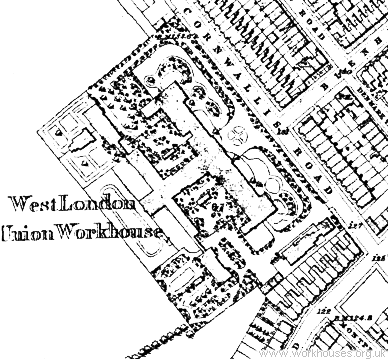
West London Union workhouse site, 1873.
A view published in 1864 shows the front facade of the proposed design.
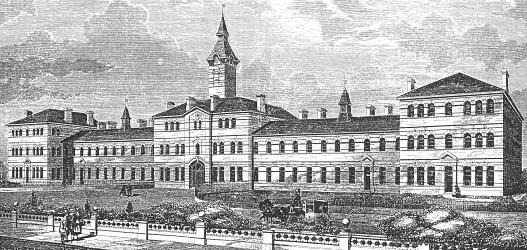
West London workhouse proposed design from the north-east, 1864.
The West London Union was wound up in 1869 with its constituent parishes being transferred to the City of London Union. By 1882, the Cornwallis Road workhouse had been taken over by the St Mary's, Islington Board of Guardians. The building was used as an internment camp during the First World War and appears never to have re-opened. The premises were sunsequently used as a storage depot for telephone equipment. The site is now occupied by the modern housing of Cornwallis Square.
The Edmonton School
Up until 1850, the union also operated a separate school housing 150 children on Meeting House Lane (now Church Road), Edmonton.
Staff
Inmates
- Inmates of Vagrants' Ward in March 1848
- Long-term workhouse inmates (1861)
- 1881 Census — Cornwallis Road workhouse
Records
Note: many repositories impose a closure period of up to 100 years for records identifying individuals. Before travelling a long distance, always check that the records you want to consult will be available.
-
The
Ancestry UK
website has two collections of London workhouse records (both name searchable):
- Westminster workhouse records are available on FindMyPast, .
- London Metropolitan Archives, 40 Northampton Road, London EC1R OHB. Holdings include: Guardians' minute books (1839-1869); etc.
Bibliography
- Higginbotham, Peter Workhouses of London and the South East (2019)
Links
- None.
 For US readers
Unless otherwise indicated, this page () is copyright Peter Higginbotham. Contents may not be reproduced without permission.