

Workhouse Literature and Arts
The poor laws and the workhouse inspired their own genre of literature and art. Popular songs and poems ranged from the sentimental (e.g. In the Workhouse: Christmas day), through the satirical (e.g. The New Poor Law in Force), to the sheer gruesome (e.g. The Vorkhouse Boy). James Greenwood's lurid account of A Night in a Workhouse spawned a whole line of undercover exposés of workhouse life by numerous "social explorers" including Jack London (The People of the Abyss) and George Orwell (The Spike) and the less well-known but equally significant Mary Higgs (Glimpses of the Abyss) and Olive Malvery (The Soul Market). In more recent times, commemoration of the Irish Famine has produced some remarkable works of sculpture.
Broadside Ballads
Sold in the streets for a penny or halfpenny between the 16th and early 20th centuries, broadside ballads were popular songs of the day, often anonymous, and were performed in taverns, homes, or fairs. The examples below, relating to the poor-law and workhouse, are from the Bodleian Library's collection. A Bodleian shelfmark follows each title.
- Queer, boys, queer Firth b.27(147))
- The poor law Bastile Firth b.34(283a))
- Pauper's Drive (Firth c.16(308))
- The Workhouse Door (Firth c.16(308))
- Lines on the death of a most cruel, hard-hearted overseer of the poor (Firth c.16(309))
- A flare up amongst the Lambeth Guardians (Firth c.16(310))
- The vorkhouse boy (Firth c.16(311))
- The St. Pancras prigging overseers (Firth c.16(312))
- Workhouse girl (Firth c.16(313))
- The Tooting tragedy (Firth c.16(314))
- Eat, ye paupers, eat (Firth c.16(315))
- Pauper and the minister (Firth c.16(316))
- The women flogger's lament of Marylebone workhouse! (Firth c.16(317))
- Joe Bradley, the runaway workhous boy (Firth c.16(318))
- A night in a London workhouse (Harding B 13(154))
- A night's repose in Lambeth workhouse (Harding B 13(155))
- The new poor law bill in force (Johnson Ballads 1148)
- The new Poor law bill (Johnson Ballads 1529)
Music
You can listen to a recording (MP3) of The Workhouse Boy (a variation on The Vorkhouse Boy above) performed by the Seven Dials Band (by kind permission of Beautiful Jo Records.
In the early 1900s, collectors of English folk songs such Cecil Sharp and Ralph Vaughan Williams, used workhouse inmates and casuals as one of the sources for their material. One of these (name unknown) was photographed at St Marylebone.
Cecil Sharp's Marylebone Man
© English Folk Dance and Song Society.
The American folk song collector James Madison Carpenter visited Britain in 1928 and recorded singers at the Ely the Insch parish poorhouse in Aberdeenshire. He also collected songs from the Ely workhouse in Cambridgeshire. The colllection has an online catalogue.
The Out of Silence choir includes a collection of workhouse-inspired songs in its Sackcloth and Silk song cycle. Visit their web site wwww.outofsilence.co.uk
The workhouse was occasionally the subject of maudlin ballads such as Standing at the Workhouse Gate by B.K. Aungur in around 1908.
Standing at the Workhouse Gate
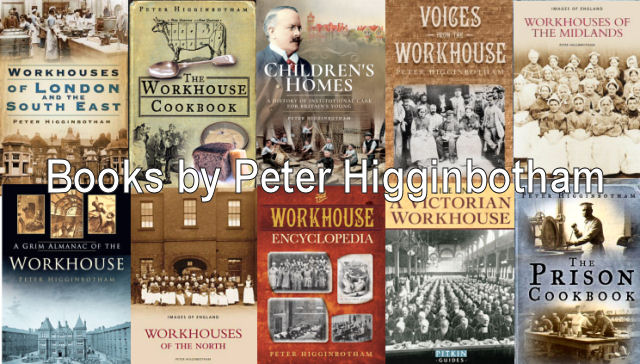
Modern songs by Peter Higginbotham.
- The Ballad of Captain Swing — Captain Swing was the mythical leader of the agricultural riots in southern England in 1829-30
- The Archway of Tears — The Archway of Tears was the local name for the entrance to the Birmingham workhouse.
Poetry
- 'A Country Parson' (1832) The Village Poor-House
- Crabbe, George (1783) The Village
- Craven, James (1887) Dirty Days Hath September
- Kipling, Rudyard (1891) The Last of the Light Brigade
- Linton, William James (1845) The Life and Adventure of Bob Thin; or, The Poor-House Fugitive
- Petrucci, Mario (2006) Fearnought (Poems for Southwell Workhouse)
- Sims, George R (1879) In the Workhouse: Christmas Day
Art
- Cope, Charles West Poor Law Guardians: Board Day Application for Bread (1841), was based on a visit to a meeting of the Staines Board of Guardians. It, shows a young widow pleading for relief for her four children.
- Luke Fildes Houseless and Hungry and Applicants for Admission to a Casual Ward
- Clement Flower Sunday Music for the Indigent Poor
- Hubert von Herkomer Old Age — A Study at the Westminster Union and Eventide
- Hubert von Herkomer Christmas In A Workhouse
- Thomas Rowlandson St James Workhouse, 1809.
- The Lurgan workhouse mural, 2006.
The Lurgan workhouse mural.
Novels
- Bennett, Arnold (1910) Clayhanger (Book 1, Chapter 5)
- Dickens, Charles (1837-9) Oliver Twist (Chapter II)
- Eliot, George (1857) Scenes from Clerical Life (Chapter 2)
- Hardy, Thomas (1874) Far from the Madding Crowd (Chapters XL-XLII)
- Law, John [Margaret Harkness] (1888) Captain Lobe (Chapter XVII)
- Orwell, George (1931) The Spike (later reused in Down and Out in Paris and London)
- Trollope, Frances (1843) Jessie Phillips
"Deep Brook Union" (from Jessie Phillips)
Plays
- Gregory, Lady Augusta (1908)
The Workhouse Ward
- Nevinson, Margaret Wynne (1911)
In the Workhouse - a Play
- Smith, John Owen (1993)
Riot Or This Bloody Crew - A Play Based on the Selborne and Headley Workhouse Riots of 1830
- Anon. (1847)
Revolt, or The Workhouse or, A Night's Hullabaloo! (A "Grand Comic Interlude" presented at the Royal Standard Theatre, Shoreditch
Shoreditch theatre poster, 1847.
© Hackney Archives, 43 De Beauvoir Road, London N1 5SQ.
Journalism / Documentary
- Anonymous (1871) A Day in the Withington Workhouse
- Anonymous (1867) A Workhouse Probe (Hursley workhouse)
- Anonymous (1867) A Workhouse Probe (Leek workhouse)
- Dickens, Charles (1849) The Paradise at Tooting
- Dickens, Charles (1849) The Tooting Farm
- Dickens, Charles (1849) A Recorder's Charge
- Dickens, Charles (1849) The Verdict for Drouet
- Dickens, Charles (1850) A Walk in a Workhouse
- Dickens, Charles (1850) London Pauper Children
- Dickens, Charles (1861) The Uncommercial Traveller - Chapter III
- Michael Dube (1999) How Charles Dickens' Fiction and Journalism Work Together
- Hastings, Rev. Frederick (1889) Workhouse Worries (from The Quiver magazine)
- Kohl, J.K. (1844)
A German traveller visits the North Dublin workhouse
- Pask, Arthur T. (1889)
A Workhouse Farm
- S.L.B. (1866)
Description of a visit to an unnamed District School in the London area.
- Wills, WH & Taylor, Philip (1850) A Day in a Pauper Palace
Social Explorers
- 'Crane, Denis' [Cranfield, Walter Thomas] (1910) A Vicarious Vagabond
- Edwards, Rev. George Z (1910) A Vicar as Vagrant (PS King, London)
- Craven, CW (1887) A Night in the Workhouse
- Gray, Frank (1931) The Tramp: his Meaning and Being (Dent, London)
- Greenwood, James (1866)
A Night in a Workhouse
Cover of A Night in a Workhouse (pamphlet reprinted from Pall Mall Gazette)
- Higgs, Mary (1904) Five Days and Five Nights as a Tramp Among Tramps — Social Investigation by a Lady
- Higgs, Mary (1904) The Tramp Ward
- Higgs, Mary (1904) London Investigations
- Higgs, Mary (1905) A Night in a Salvation Army Shelter
- Higgs, Mary (1906) Glimpses into the Abyss (London: P.S. King)
- London, Jack (1903) The People of the Abyss
- Malvery, Olive Christian (1907) The Soul Market
- Sims, George R (1883) How the Poor Live
- Stallard, JH (1866) The Female Casual and her Lodging
- Wyrall, Everard (1910) The Spike
![]() |
![]() |
Periodicals
- The Banbury Guardian; or Monthly Poor Law Register

(click on image for enlarged version)
Biography
- Anonymous (1885) Indoor Paupers by 'One of Them'
- The Diary of William Barlow, workhouse master of Bishop's Stortford (1848-1850)
- George Green Gabb, Master of Droitwich Workhouse Master (1849-53) compiled by Martin Gabb.
- The colourful career of William Bragger, Master of Wrexham workhouse (1857-1863) researched by his great-great-great grandson Andrew Taylor.
- H Preston-Thomas (1909) The Work and Play of a Government Inspector
- Shaw, Charles (1903) When I was a Child includes memories of the Wolstatnton and Burslem workhouse at Chell which Shaw entered as a child in 1842.
Humour/Satire
A sardonic postcard from 1907 — "Wots the good of working when there's an 'ome for nothink"
A humorous interpretation of the play-title The Beauty of Bath, c.1906.
A 1903 postcard indicating the fate of some returning invalids from the Boer War
Punch Magazine's typically irreverent take on the Guardians interrogating a relief applicant in 1899.
Sculpture
Irish National Famine Monument at Croagh Patrick in Co. Mayo, 2000.
© Peter Higginbotham.
Roscommon famine memorial, 2003.
© Peter Higginbotham.
Famine memorial at Sligo, 2003
© Peter Higginbotham.
'Famine Family' by James McKenna at Athy
© Peter Higginbotham.
Miscellaneous
- Casual Ward graffiti collectd by Poor Law Board Inspector Andrew Doyle in 1865.
This page () is copyright Peter Higginbotham. Contents may not be reproduced without permission.