


The BBC History Magazine — Facts or Fiction?
The BBC History Magazine claims to be "authoritative history, written by leading experts". Its January 2007 issue contains an article entitled: Workhouses: Pauper Paradise or Hell? by Simon Fowler which is said to "challenge the popular view" of the workhouse. Disturbingly, for a publication which boasts an impressive list of academics on its "advisory panel", and which also carries the BBC imprimatur, the article contains a large number of highly questionable assertions. These include:
- "By the 1870s one-third of the population over 70 lived in the workhouse".
- According the official reports of 1871 census, around 630,000
people aged 70 or over lived in England and Wales. However, only 27,000 (just over 4%) of these were recorded as residing in workhouses. [Source: British Parliamentary Papers]
- "The first purpose-built workhouse is generally thought to have been established in Bristol in 1696."
- Contrary to "general thought", purpose-built workhouses were around
much earlier than 1696. For example, Newbury, Sheffield, and Newark had
erected such establishments by 1630, and new workhouses were built at Taunton
and Abingdon in 1631. Although the Bristol Incorporation was indeed formed in 1696, it opened its first workhouse in 1698 in rented premises, and purchased a second building the following year. Although a number of other urban incorporations were set up in 1698 and 1699, there is little evidence that they were directly influenced by Bristol's experiences. [Sources: John Cary, An account of the proceedings of the Corporation of Bristol... (1700); EM Leonard The Early History of English Poor Relief (1900)]
- By the 1830s, "most villages and towns" already had a workhouse
- Parliamentary returns in 1776, 1803 and 1815 indicate that less than 30% of parishes or townships had workhouses. [Source: British Parliamentary Papers]
- "The Poor Law was finally abolished in 1930"
- The 1834 Poor Law Act was not finally repealed until 1966. Parts of
1601 Poor Relief Act lingered until 1967. The major change that took
place in 1930, was that the responsibility for the administration of
what then became called "public assistance" passed from Boards of
Guardians to county and borough councils. [Source: www.justis.com British statutes database]
- Under the 1834 Poor Law Amendment Act "all outdoor relief was to be abolished... any pauper who sought assistance was to be 'offered the house'."
- The actual prohibition on out-relief was made only in relation to the able-bodied and their families, and even then could be circumvented in cases of "sudden and urgent necessity". In no year
between 1840 and 1900, did total national expenditure on indoor (i.e. workhouse) relief exceed that for outdoor relief. [Sources:
Sidney & Beatrice Webb English Poor Law Policy (1910); Karel Williams From Pauperism to Poverty (1981)]
- Apropos Sundays in the workhouse "Politician Will Crooks thought 'time could not be more terrible anywhere'."
- Crooks did indeed make this remark, but his comments were actually about the time he spent as an eight-year-old at the South Metropolitan District School, not at a workhouse. [Source: George Haw From Workhouse to Westminster: The life story of Will Crooks, M.P. (1910)]
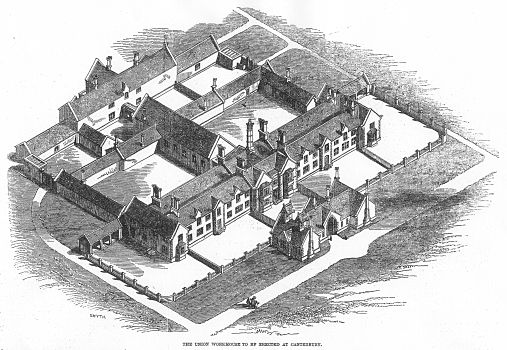 "Andover workhouse shown in 1846"
- In fact, the illustration printed in the article is actually a
proposed design for the Canterbury Union workhouse. It was a radical
departure from the older "square" layout used at Andover, for example lacking a supervisory
hub, and having exercise yards for the aged bounded by open fences rather than high walls, and with covered play-sheds for the children. [Source:
Illustrated London News, 7 November 1846]
(Note: BBC History Magazine have recently informed me that the image they used, which came from a picture library, had a contemporary caption identifying it as Andover. However, I suggest that any "leading expert" would know better.)
- "Even today, the majority of surviving workhouse sites are still used by hospitals"
- This may have been true twenty-five years ago, but not now. A survey of around 400 former union workhouse sites, where there are at least some surviving workhouse structures, indicates that only a third of them are still used by hospitals or geriatric care providers. The largest proportion, around 195, have been converted to private residential use, while a further 80 have been turned over to business, educational, or museum use. [Source: author's own research]
- "Men, women and children would have eaten in separate dining rooms or in different shifts"
- Only a few very large workhouses had separate dining rooms for men and women. Most commonly, the workhouse chapel was also used as the communal dining-hall where male and female inmates would have been allocated segregated areas in which to sit. [Source: Kathryn Morrison The Workhouse (English Heritage, 1999)]
An unrepentant Mr Fowler has since replied that I am "missing the point" and that he is writing for a "popular" rather than academic audience. This seems to be extremely patronising to readers of "popular" publications — the "point", surely, is that they are just as entitled to be presented with accurate facts as anyone else. Correct dates, for example, allow the reader to place events in relation to others and come to conclusions which would be very different were the dates to be different. One only has to think of recent events relating to the Iraq war and when exactly certain people knew that certain intelligence might not be reliable.
Anyway, do excuse me while I settle back to reading a jolly little book called 1065 And All That while I listen to the 1814 Overture and sip a refreshing glass of Kronenbourg 1667...
 For US readers
Unless otherwise indicated, this page () is copyright Peter Higginbotham. Contents may not be reproduced without permission.