


Tracking Down the Smallpox Ships at Dartford
On a snowy day in February this year, I joined BBC Radio 4 reporter Angela Robson on the trail of London's forgotten smallpox isolation ships which were moored on the Thames near Dartford between 1883 and 1903. On behalf of the programme Making History (broadcast Tuesdays, 3pm) and listener Chrissie Philips-Tilbury, we were trying to unravel the story of the ships and what had happened to Chrissie's great-great grandparents who, according to family legend, had died on board them.
Our journey started in the north London suburb of Hampstead where in 1870 a new smallpox hospital was the target of protests from local residents who included Sir Rowland Hill, the inventor of the penny post. The hospital had been erected by the Metropolitan Asylums Board which had been set up in 1867 to administer care for certain categories of the sick poor in metropolitan London.

Hampstead - the start of our trail
© Peter Higginbotham
Eventually, after more than a decade of argument, it was decided that the treatment of smallpox should be carried out on ships placed at isolated locations on the Thames. In 1883, two old wooden battleships, the Atlas and Endymion, and a former channel passeneger ferry, the Castalia, were converted for this purpose and moored at Long Reach near Dartford.

The Atlas, Endymion and Castalia
© Peter Higginbotham
Passengers were transported to the ships by ambulance steamers from wharves at Blackwall, at Fulham, and at Rotherhithe (now the site of the London City Farm).
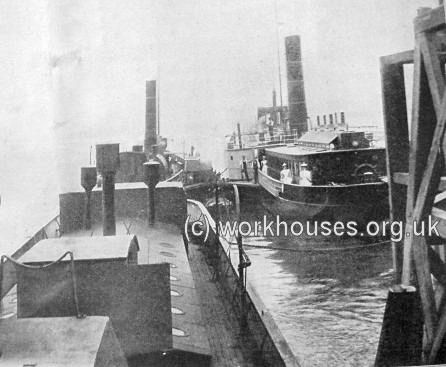
River ambulances Albert Victor, Geneva Cross, and Maltese Cross at South Wharf, 1902

Chrissie and Angela at South Wharf
© Peter Higginbotham
Today, Long Reach is still an isolated, windswept spot with a flood barrier providing a view of where the smallpox ships were once moored.

Long Reach today
© Peter Higginbotham
Listen to our search for London's smallpox ships on Radio 4's Making History program (3pm, Tuesday May 18th). For more information, see the separate pages on smallpox isolation ships and the river ambulance service.
 For US readers
Unless otherwise indicated, this page () is copyright Peter Higginbotham. Contents may not be reproduced without permission.