


Workhouse Records and Archives
Introduction to Workhouse Records and Archives
Records and other information relating to workhouses and to the poor-law system can be found in a wide variety of places, for example:
- Central repositories, e.g. the UK National Archives and the Family Records Centre
- Local, county, and metropolitan record offices
- Local and family history study centres
- Specialist academic and medical archives
- Parliamentary Papers
- Old newspapers and trade papers
- Old local and trade Directories
- Documents in private ownership
- Internet sites
- Commercially produced genealogical CDs
With the major overhaul that took place with the 1834 Poor Law Amendment Act, records can be conveniently divided into those created before and after that date.
Pre-1834 Records
The majority of pre-1834 workhouse-related records are parish documents that will mostly now be found in local county or metropolitan record offices. These records may include:
- Parish Overseers' Accounts - list poor rates collected and allowances paid. Related documents include rate demands, receipts, and summonses for refusal to pay.
- Churchwardens' Accounts - details of expenditure on the church and church-owned property.
- Vestry Minutes - general administration of parish matters, sometimes including poorhouses.
- Settlement Records - settlement certificates, settlement examinations, and removal orders.
- Bastardy Documents - claims as to the identity of fathers, records of maintenance payments etc.
- Apprenticeship Records - details of those apprenticed out by a parish.
- Corporate Records - records of Poor Law Incorporations, Gilbert Unions etc.
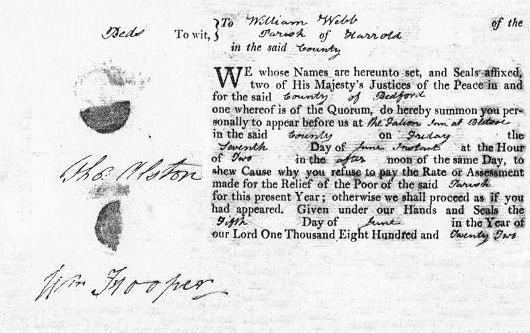
Example of a poor rate summons from 1822.
The settlement laws generated a great deal of administrative activity. Labourers wanting to move around had to obtain settlement certificates from their home parish.
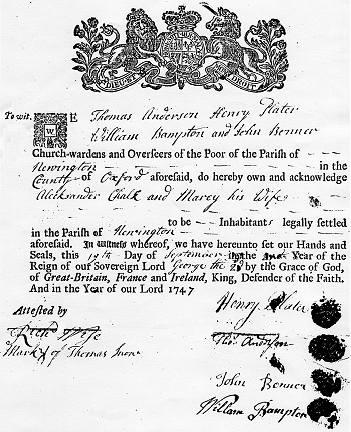
Example of a settlement certificate from 1747.
Someone who "became chargeable" to a parish in which they were not settled might have to undergo a settlement examination by a magistrate. Below is an example of an examination from 1829 in the Berkshire parish of Thatcham.
An unsuccessful examination would generally result in the person's forcible removal back to their home parish.
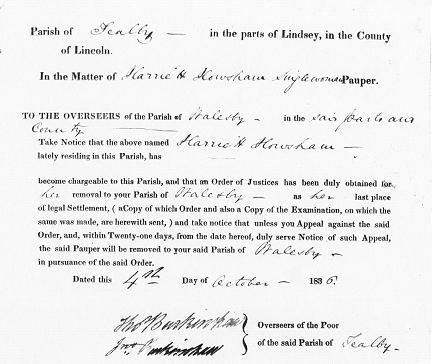
Example of a removal notice from 1836.
Post-1834 Records
After 1834, poor-law administration and workhouse operation centred around the poor-law union, a body administered by its locally elected Board of Guardians. Each union was a collection of parishes, typically twenty or thirty, often centred around a market town or other centre of population. All of the poor law unions are listed, county by county, under the Workhouse Locations section of the menu at the left of the screen.
A basic requirement for researching post-1834 workhouse records is therefore identifying which union you are interested in. If you don't know what union a particular parish or place belongs to, you can try entering its name of this site's "Search" box. Alternatively, use Mary Hallett's Poor Law Union Database. Boundary and other administrative changes mean that parishes occasionally changed which union they belonged to.
Locally Held Union Records
Records concerning the day-to-day administration of a union and its workhouse are usually found in local record offices — most commonly the county record office in which the union was located. Where a union straddled county borders, or where boundaries have changed over the years, records may occasionally have ended up in more than one record office.
Records to be found in local archives include:
- Board of Guardians minute books
- Ledgers and Accounts
- Master's journal
- Chaplain's books
- Orders of removal
- Orders for medical relief
- Orders for maintenance under the 1845 Bastardy Act
- Registers of various sorts, including:
- Admissions and discharges
- Porter's book
- Indoor pauper lists
- Births, baptisms, deaths, burials
- Creed register (religious affiliation)
- Punishment book
- Leave of absence
- Bathing register
- Inmates' own clothing register
- Children under control of the Guardians
- Children boarded out
- Lunatic register
- Register of mechanical restraint
- Out-relief payments
- etc. etc.
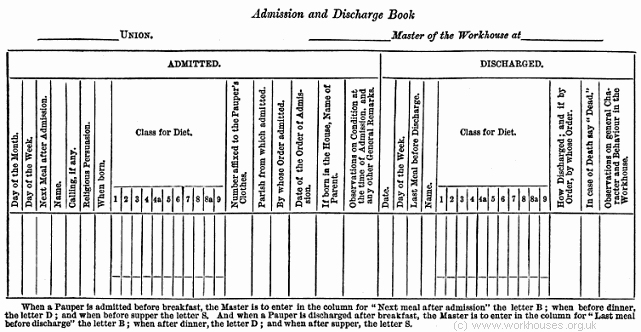
Admission and Discharge register.
Although not linked to poor relief, Vaccination registers may also be of interest. In 1840, poor-law unions were made responsible for administering the new scheme for free vaccinations, aimed primarily at children. These were originally voluntary but became became compulsory from 1853. As well as vaccination information, these registers include details of each child's date of birth, parents, address etc.
It should be emphasized that the records which survive for different unions vary enormously — in some case, extremely little remains. An indication of the existing records and their location is given at the end of each union's individual web page elsewhere on this site.
- County and metropolitan record offices that hold poor-law records are listed on a separate page on this site.
- Many Poor Law records are included in the National Register of Archives — try doing a "Corporate Search" and entering a search term such as "poor".
- The locations of archives can be found available in the ARCHON Directory of UK Archives. ARCHON lets you browse an alphabetical list, and also search its database.
- For London unions and parishes, the The London Archives is the best starting place. The LA produce a useful Guide to Poor Law Records from 1834 Onwards. Other archives in the London area may be located via the AIM25 (Archives Inside the M25) web site.
- For Scotland, the Scottish Archives Network is a good starting point for locating poorhouse records, while general births/marriages/deaths and census records can be accessed via Scotland's People.
- In Ireland, poor law records are held in a variety of archives including the Public Record Office of Northern Ireland, the National Archives of Ireland, and a number of County Libraries.
If you can't visit the appropriate record office, they may be able to carry out research on your behalf but will normally charge for this.
The Poor Law Union Records guides by Jeremy Gibson and others provide a very comprehensive (although sometimes dated) directory of surviving poor-law records in England and Wales.
Transcriptions of local workhouse records have been published in print or on CD by a number of family history societies and companies such as the Eureka Partnership. Many of these are available via the FFHS Genfair online store.
Workhouse Records in The National Archives
The UK National Archives holds a variety of material relating to the central administration of poor-law unions. This includes:
- Correspondence between the Poor Law Commission/Board and union officials. Part of the correspondence for more than twenty unions is now searchable online on the TNA website with an accompanying guide available from The British Association for Local History.
- Staff lists (held centrally to prevent discharged employees obtaining a union post elsewhere)
- Workhouse plans
Most poor-law material filed under the MH (Ministry of Health) sections of the TNA catalogue. The catalogue index can be searched online, although you need to visit the TNA to actually see any of the documents (other than the above-mentioned correspondence).
The TNA website also hosts other useful resources such as:
- The Hospital Records database database contains information relating to the availability of records for around 3,000 hospitals, many of which began life as workhouses.
- The A2A database is a searchable catalogue of a large number of English archives. At the bottom of the opening screen, click on the Search A2A button. Then enter your requirements on the search form. Note that selecting the Archive Category of Poor Law Unions will restrict the search to documents created BY Poor Law Unions.
The NA now also has a global search facility to search across multiple databases, including some external archives.
Other Records
A variety of other archive resources may be able to provide information relating to a particular workhouse, member of staff, or inmate.
Local newspapers often carried reports of Boards of Guardians meetings and any other newsworthy workhouse-related incidents that occurred. Advertisements for staff or the supply of goods also featured regularly.
Parliamentary Papers relating to the Poor Law Commissioners, Poor Law Board, and Local Government Board are extensive. Online versions can be consulted free at the National Archives at Kew. Although largely concerned with matters of finance and policy, they occasionally contain material relating to individuals. For example, in the 1850s, the annual reports of the Committee of Council on Education listed the names of all the workhouse teachers achieving a particular certificated grade. In 1861, a report on Paupers in Workhouses listed, by name, every workhouse inmate at that time who had spent more than five years in residence in a particular workhouse.
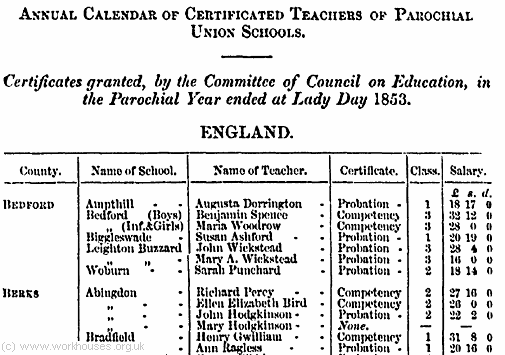
Part of the 1853 calendar of workhouse teachers gradings and salaries.
© Peter Higginbotham.
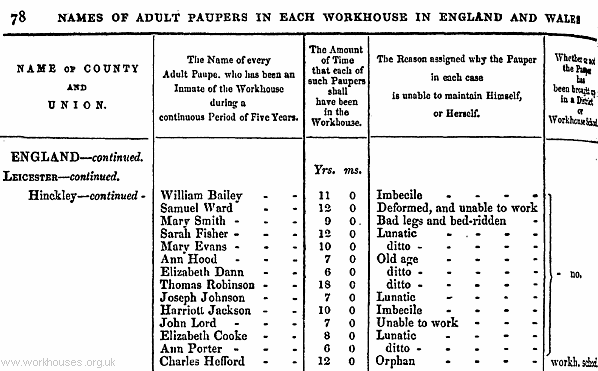
Part of the 1861 survey of paupers in the workhouse for more than five years.
© Peter Higginbotham.Trade Newspapers such as the Poor-Law Officers' Journal, Local Government Chronicle, and Knight's Official Advertiser, were aimed at union officers, workhouse staff etc. and often featured material on specific unions and workhouses. One particularly of interest to family historians is the Poor Law Unions Gazette published from 1857 to 1903. Its contents consisted entirely of detailed "wanted" descriptions of men who had deserted their families and left the union to take care of them.
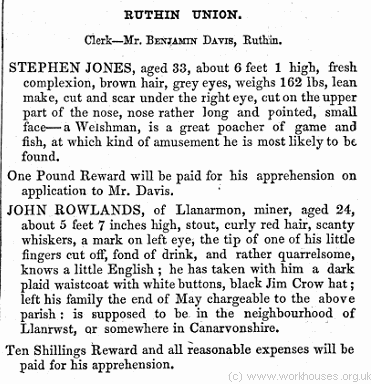
Poor Law Union Gazette extract, 1860.
© Peter Higginbotham.
Help — I'm Stuck!
Take a look at my Frequently Asked Questions page.
Bibliography
- Cole, Anne (2000) Poor Law Documents Before 1834
- Durrant, Peter (ed.) (1997) Berkshire Overseers' Papers 1654-1834 (Berkshire Record Society)
 For US readers
Unless otherwise indicated, this page () is copyright Peter Higginbotham. Contents may not be reproduced without permission.